Category: Travel

  • The fish tank off Chinese Hat

    26-JAN-11: Sombrero Chino

    The Flamingo chugged along during lunch and siesta until we reached an island called Sombrero Chino mid-afternoon. It really did look like a broad-based conical Chinese Hat. Not sure why I didn’t take a picture of it.

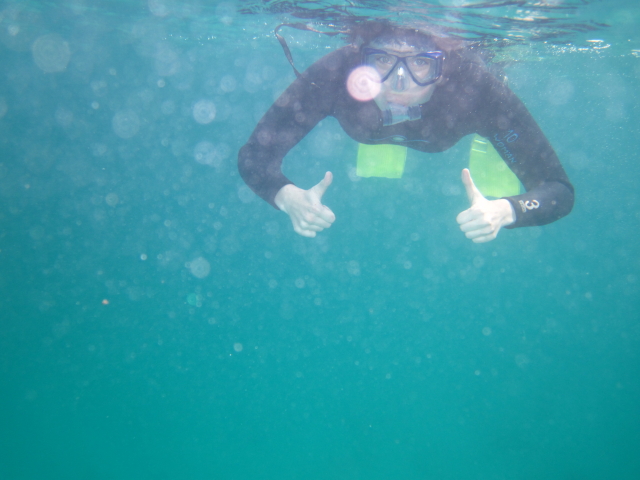
    2011-01-26 katieOur underwater shots the prior times snorkeling had been green and dull. I thought maybe turning the flash on would be a good idea to brighten things up, and Katie figured out how to set it to “always on.” This wasn’t a brilliant idea, as you can see from the photo I took of her, below (the flash bounces light off of all the crap in the water).

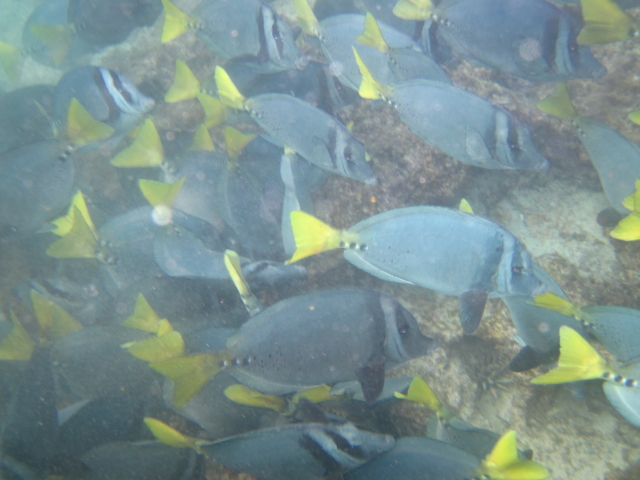
    Still, photography was easier at Chinese Hat: Malina said the water conditions were so clear that it would almost be like swimming in a fish tank. She was right. It was brilliant.

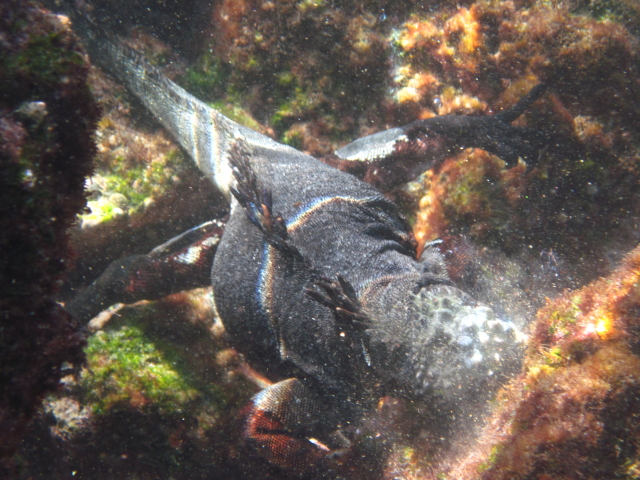
    2011-01-26 iguanaThe first bit of excitement was a marine iguana feeding on algae in a tiny little inlet. With Katie and a fellow passenger, Jeff, in the inlet, I didn’t have much room to maneuver. I was so close to the iguana, the small waves were enough to move the iguana’s head in and out of the shot. I couldn’t zoom out any further, and I couldn’t move any further back with the other two people there. I ended up without any decent shots in the minute before the iguana went back on land. The shot below was the best I could manage.

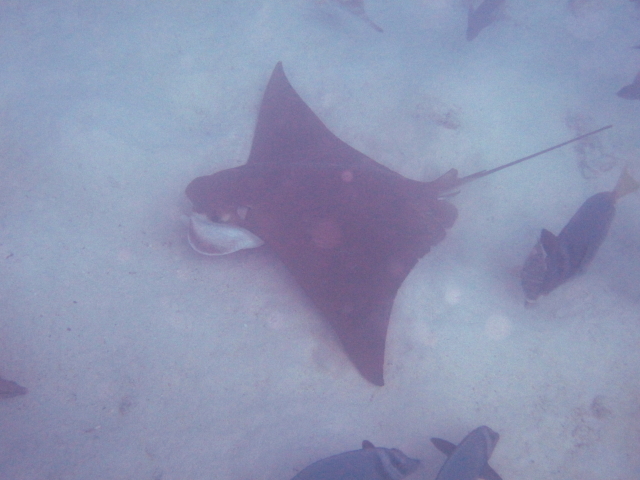
    2011-01-26 rayThe next bit of excitement turned out to be a feeding frenzy caused by lobster heads dropped off a fishing boat. In addition to huge clumps of fish, we saw a huge ray. But the water was deep enough, I couldn’t swim down to get a shot of the ray from the front.

    Having the flash on all the time drained the battery fast, so we missed some penguins at the end of the swim. But it was a great day snorkeling.

    2011-01-26-fish

  • Endless blue-footed boobies

    25-JAN-11: Isla Isabela

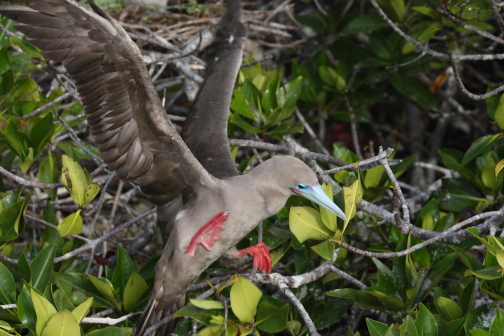
    After snorkeling, we had a panga (Galapaguena for "Zodiac" boat) ride along the cliff-coast of Isla Isabela to see penguins and flightless cormorants and blue-footed boobies.

    I shot well over 800 today, but we saw so many blue-footed boobies on this ride, even I got tired and stopped shooting. Malina, our guide on the panga ride, told us that this wasn't normal. Most of the year, you would be happy to see thirty or forty blue-footed boobies in a day. We must have seen a thousand in just an hour on that panga.

    Below is my favorite shot… at least, considering I only took a cursory swing through the hundreds of frames I shot. I'm sure there may be another one buried in there.

    Blue_footed_boobies

    I haven't really gone through the penguin shots in any level of detail either. There were so many. But this one just jumped out. Look at that tongue.

    GPS_00037

  • Swimming with a Sea Lion

    25-JAN-11: Isla Isabela

    In the afternoon, we snorkeled in a bay on Isla Fernandina. The conditions and visibility were atrocious. I kept my head down under the water mainly to avoid looking at the scum floating on the surface. Oddly enough, I wasn’t bothered by my hair going through the muck, but watching Katie swim through it…

    Anyway, it was hard to see more than a few feet: we had to stay right next to the rocks, ahem, to the rock cliff to see anything. There weren’t many fish. A couple of stars. Not much to see at all, actually.

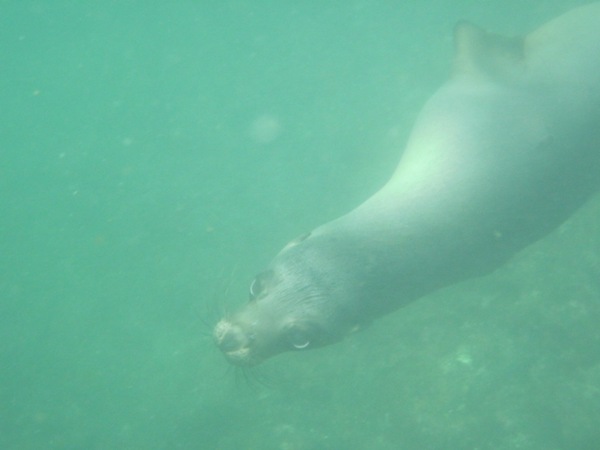
    2011-01-25 sealUntil I saw a sea lion dart directly underneath me. And then back in front of me. And around me. It was magic. I was checking out the sea lion, and it was checking out me. But the moment didn’t last long: there were other humans for the sea lion to investigate, and it disappeared in the green muck.

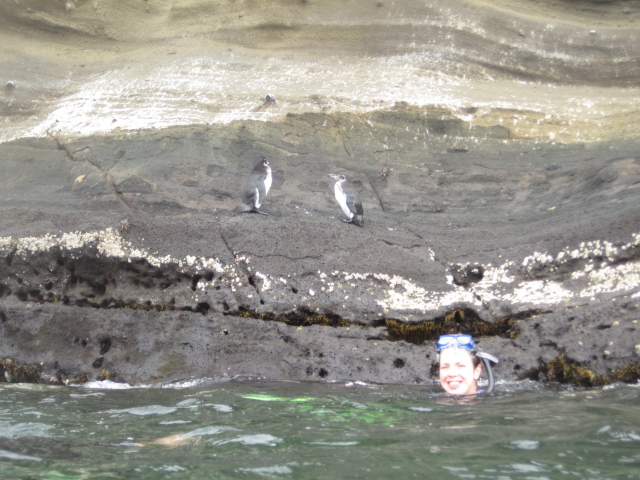
    A couple minutes later, I heard Katie shouting for me to get over to her. There was a Galapagos penguin swimming with us. By the time I swam over, it was out of the water and on a little ledge along the cliff. It and a friend were just hanging out, and Katie wanted me to take a picture of her near them. On impulse, the day before we left, we decided to purchase an underwater Canon point-and-shoot. I had trouble figuring out how to use it: button-to-shutter response just wasn’t as instant as with my 1d, and that meant I thought the shot was done when the shutter was still open. Yeah, it’s not like the shutter is open for very long, but if you move the camera when taking a shot, it’s going to be blurry. Add in the movement of the waves… I took three of Katie with the penguins, and only one wasn’t a modern painting of gray streaks. The one that did come out… metered badly. Blown out a bit.

    2011-01-25 katieThat was it for the excitement, though. Someone called out they saw a sea turtle, but with visibility so low, you had to be right on top of it to see anything.

    I had a bit of a scare before the penguins, though: my right calf muscle suddenly cramped up into a tight, baseball-sized knot of pain. The rest of the time, I was swimming either with one leg, or just by moving my feet, rather than my legs. Thankfully, the pain in my right toe mostly subsided with all the salt water: all I got from the flipper rubbing against it was a dull ache. Cut right big toe, abrased left ankle, sore right calf muscle. What else could happen?

  • Don’t step on the iguanas

    25-JAN-11: Isla Fernandina

    Another long night of dozing, not sleeping as the Flamingo crawled about 150 miles west to Isla Fernandina; from the northeastern most island, to the far northwest of the archipelago.
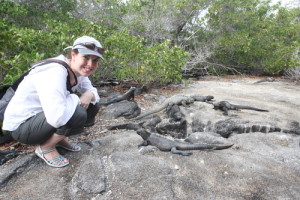
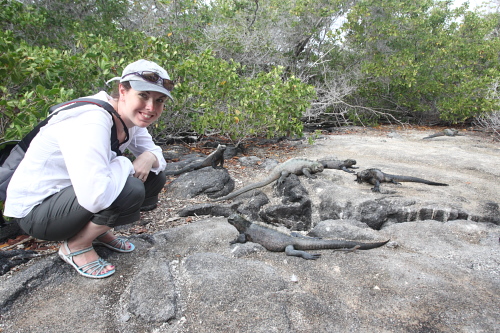
    2011-01-25 katie-iguanaWithin five feet of our landing point, there were six or seven iguanas sitting there amidst a tiny clearing in the mangrove trees. All the cameras came out, while Karina, our guide, attempted to tell us that the most important thing on this island was to not step on the iguanas, but that if you do, don’t freak out if they spit out you: it’s just salt water.

    Right, how could I step on an iguana? Yeah, they have camouflage, but… there can’t be that many.

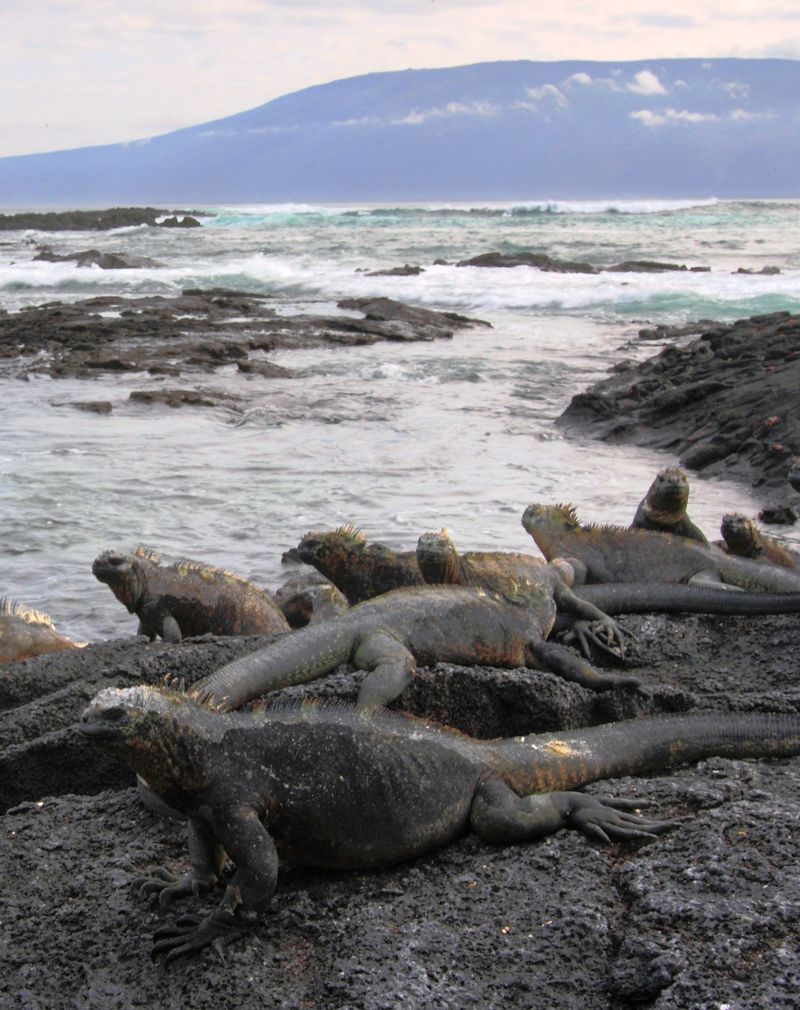
    When we got out from the little clump of mangrove trees to the rocky coast, it was iguanas as far as the eye could see. Stepping on one? The challenge in some places was finding a place to step that didn’t already have an iguana resting there. There must have been a thousand little marine iguanas sitting motionless on the pahoehoe lava flows.

    I tried to take a landscape with the iguanas in the foreground, but it didn’t turn out well: black iguanas on black rock, white foam from waves, pale blue sky and white clouds… Either the mid- and back-ground was blown out, or the foreground was so dark you could barely distinguish the iguanas from the rock. I tried everything I could think of. A circular polarizer. A graduated neutral density filter. I probably needed a much stronger neutral density filter to fix that contrasty mess, though.
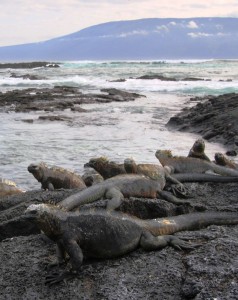
    2011-01-25 iguanasI also was struggling with my “tripod.” I didn’t bring my usual tripod, because it can be a hassle to handle, and it adds a ton of weight to my backpack. Also, with the subject matter of the Galapagos, I didn’t think I’d be taking many landscapes or sunset shots that’d require a tripod. A monopod should be enough to steady my hand for wildlife shots, and one of those twisty little “wrap-it-around-a-tree-limb” tripods would serve if I had any landscape opportunities (you want your camera close to the ground for those shots anyway. Anyway, the little thing was awkward to set up, and so low to the ground I could barely see through the viewfinder. All of my shots ended up a couple degrees askew from the horizon line.

    Meh. The shot above… I brightened up the shadows as much as I could, cropped out half the shot to make it a vertical landscape, and did a bunch of color adjustment to bring out the blue in the waves and the lighter brown on the backs of the iguanas. Still not a great shot. As I look at it, I think I would’ve done better to get way more iguanas in the foreground.

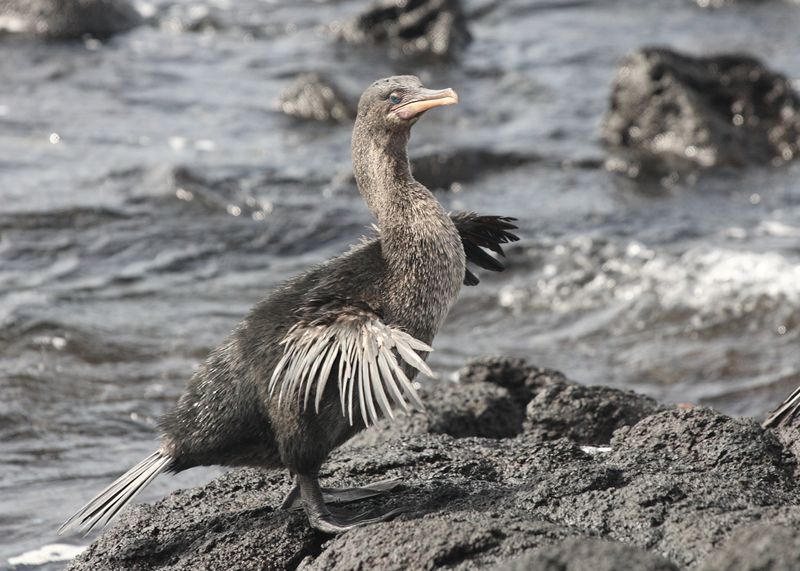
    The saving grace of the photographic day were the flightless cormorants. Further on in the walk, we came upon a group positioned such that the morning sun was behind my back, lighting up the cormorants beautifully. Then one popped out of the water, stood off by itself, and spread its stubby little wings out to dry. And every once in a while, it turned its head to catch the warmth of the morning sun, lighting the shot perfectly.
    2011-01-25 cormorant

    Panchito, the bartender gave me a couple band-aids the day before for my big toe. I went through two that morning, but with the strap of my sandal rubbing against the wound… by the end of the walk, I was limping along, resting my weight on my monopod like it was a cane, and wearing the sandal like a reverse flip-flop (the strap along the ankle the only one in use).

    I had another battery mishap: the shoulder strap on my camera suddenly came loose, and the camera landed on the battery casing. The impact was hard enough that the casing cracked and bent outward. Something tells me the weather seals were compromised. I hope it doesn’t rain when I’m out shooting.
  • Stupid Birds

    2011-01-24 boobies and people

    24-JAN-11: Isla Genovesa

    Seriously. Just. Plain. Stupid.

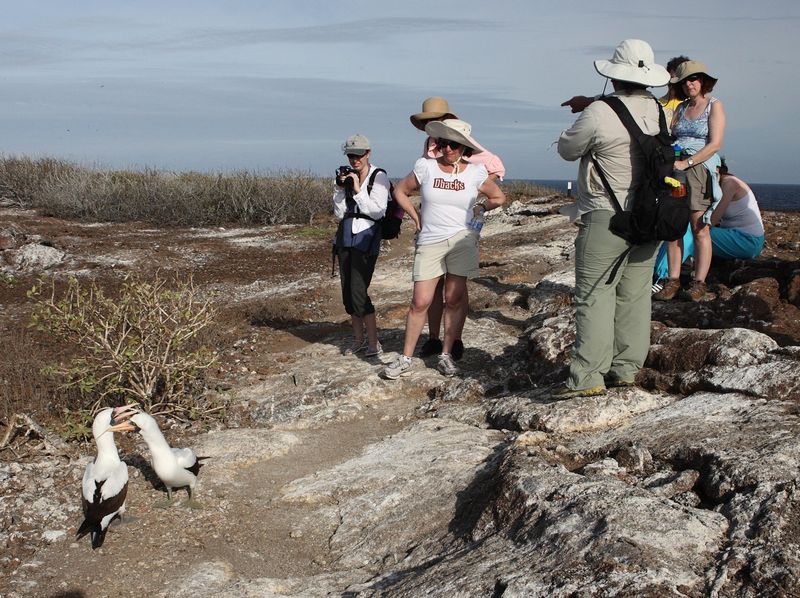
    This was my first reaction to the Nazca Boobies we encountered on Isla Genovesa. They were just standing there, on the ground, waddling like penguins and not moving when we got close. What bird doesn’t know to fly away when a human gets close, even if it’s just to hop into a tree or onto a rock just out of reach?2011-01-24 redfooted boobieWe saw a ton of birds today. Nazca Boobies. Red-footed Boobies. Great Frigate Birds. Mockingbirds. Lava Gulls. Swallow-tail Gulls. And they had no fear. Not a one.

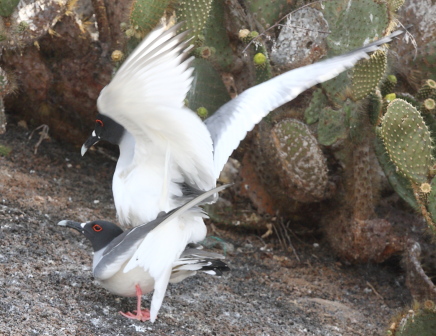
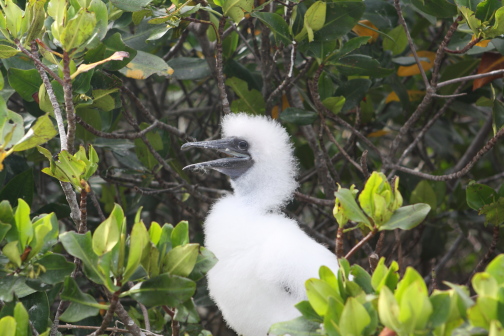
    2011-01-24 mating gullsWe saw a pair of Swallow-tail Gulls mating (right). We saw a ton of chicks, from ugly looking frigate bird chicks to these downy-white balls of cotton that would eventually mature into red-footed boobies.

    About halfway through the hike, my camera’s battery died. I couldn’t believe it. I had charged that thing the night of 22-JAN-11, and shot less than 200 frames on 23-JAN-11.  That battery used to last for 48 hours of intense shooting before it died. I guess after five years, I need a new battery. Katie lent me her camera for most of the rest of the walk.

    2011-01-24 baby boobieWhile taking a shot of one of the red-footed booby chicks, I lost my balance and scraped my left ankle badly enough that it was bright red with blood. That wasn’t enough to stop me trying to get that same shot again (the chick was probably seven feet above sea level, and this one steep rock put my head about eight feet above sea level) and I lost my balance a second time, this time cutting my big toe on my right foot pretty badly, enough for it to actually bleed and me to feel nauseous about ten minutes after. The cuts were surprisingly deep and razor straight; a reminder that the rocks are glass-sharp lava formations.

    I handed Katie back her camera after I felt nauseous. I wasn’t about to take any more shots.

    The cuts made it increasingly hard to walk with my sandals on, and the thought of participating in the next activity—snorkeling—with fresh cuts was not appealing. We went kayaking for an hour or so, which was a relaxing alternative, even if salt water kept dripping from my oar onto my wounds.

  • Absolutely nothing

    31-JAN-11: Isla Santa Cruz

    That’s basically all we’ve done for the past 24 hours. Hopped in the pool, walked around Puerto Ayora, had a couple meals. I’ve been entranced by the little band of ducks that live in the hotel pool. They’re tiny and cute.

    My back is getting better. At lunch yesterday, I couldn’t find a comfortable position to sit. It hurt constantly. Today, it only hurts when I stand up or sit down.

    We have WiFi at the hotel, so I’ve finally be able to catch up on Egypt.

    I don’t think we’re going to do much of anything this afternoon or tomorrow either. It’s nice being lazy after such an busy week on the Flamingo.

  • Chichicastenango and a shy almost-smile

    I took a perfect picture today in the last 30 minutes of my visit to Thursday’s market in Chichicastenango (gallery), the last real 30 minutes of my vacation. It was of a young woman–maybe 15, though she could have been a few years younger and maybe even 10 years older–wearing a huipile of dark, almost iridescent blue. She was one of many women in traditional dress wandering the market with textiles and jewelry for sale.

    Most were much older, though, and many had young children–maybe three or four–in tow selling little trinkets for a quetzal or two. Most of the women were also more confident, outgoing, like the ones in Antigua who now know me by name, ask how my day was, and touch my forearm or knee when leaving or after a joke.

    No, she was shy, albeit persistent. She wouldn’t interrupt or block your path, but instead would wait quietly until you turned her way. She caught my eye within 30 minutes of our late, 10:30 a.m. arrival (damn micro bus driver said he just needed to go to the bathroom–we found him 30 minutes later eating breakfast). Somehow, though, she was always facing the other way, or my line of sight was blocked by someone taller (didn’t take much to do that). Either that, or she was inches away, trying to get my attention.

    When she found me at 2 p.m., she tried to sell me a small bracelet for five quetzales. I countered, five quetzales for a picture. She agreed. The shy almost smile, the tilt of her head, the brilliant colors… well, you can see for yourself. Best picture I’ve taken in years, in my opinion.

    Perfect

  • An incredible sense of direction

    No, not incredible: well-nigh infallible. I once spent four hours wandering aimlessly in White Sands National Monument, going a dozen different directions among acres of indistinguishable white sand dunes, and came out just 30 feet from where I went in. Yes, mind you, I thought I was 30 feet above were I went in, when in fact I was 30 feet below and walked 100 yards before I figured it out. But I knew that I was close.

    So, I met these two very personable young British women in the taxi to Antigua, and after I helped them get a hotel I suggested we have dinner. I told them I would meet them at their hotel after I checked into mine. I didn’t want them to come to my hotel, because, if they got lost in the dark, they wouldn’t be able to ask for directions–neither spoke a word of Spanish.

    Antigua_map
    Just to be safe, I took my Rough Guide to Guatemala with map of Antigua just in case (inset right–click to enlarge). But it was easy. My hotel, Posada La Merced, was in the south-southwestern corner of the city at the "Y", and they were in the northwest corner of the city near the "C." The city was laid out in a grid, in the streets were all numbered like in Manhattan (Avenidas were N/S, Calles E/W, and instead of Fifth Ave. splitting the city into East and West, Parque Central split it in all four directions). The avenues even numbered in the same directions: Avenues went lower in number the farther east one went. Streets were different–the highest were the furthest south.

    Anyway, all I needed to do was walk from West 8th Street and 5th Avenue South to West 1st Street and 7th Avenue North… Simple, right? Not quite. Read on…

    (more…)

  • Changeable weather

    I was out on the nature path by 7:15 a.m. this morning. I was actually weirded out: this was a very different jungle, and it was obvious no one had been on the path in days, if not longer. I was utterly alone. Within five minutes, I heard a huge amount of noise in the underbrush to my right. It took a moment for me to remember I didn’t have to worry about the packs of man-eating hogs from Corcovado, Costa Rica (seriously, the guides tell you that if you encounter wild hogs in Corcovado, you need to get up in the trees immediately or you are pig feed). It was probably just a tapir, but I couldn’t see more than a few feet into the underbrush. In fact, I didn’t see anything at all on this site. I heard lots: monkeys, birds, small critters just a few feet from the trail…

    Then it suddenly started raining buckets. I had my poncho, but the added heat was unbearable. I turned around maybe 1 km into the 5 km hike, and far from the Mirador overlooking the entire Tikal area.

    Bowl
    After breakfast, I decided to check out the pottery and engravings museum. Much to my surprise, there was not a prohibition on flash photography like you will find in most Western museums, so I began shooting. But everything was over exposed, just like some of my shots of monkeys. With the monkeys, I didn’t think much about it: a flash is not designed to work with a zoom lens, let alone the Better Beamer flash extender, so you’re going to get some overexposed and underexposed shots. But this was different: it was within the working range of the flash. I knew it had to be the light meter, but everything seemed to be set properly. After fumbling around with the camera for a few minutes, I noticed that on this one odd, hard-to-reach screen the meter was set to take pictures 1.5 stops overexposed. The screen had the little lightning bolt symbol that represents a flash. I had no idea one could even have a separate meter setting for a flash. Makes sense, but… shouldn’t it just adjust the regular meter setting? You know, load it as a new default, and then let you adjust the regular setting? It took me a few more minutes to figure out how to set it back to normal. Bloody aggravating, but it takes time to learn a new camera.

    When I got out of the museum, the damn weather was perfect. Blue sky with maybe 50% cloud cover, all puffy white cotton balls and broken into picturesque clumps. Plus, the weather was dry and cool–well, dry and cool relative to prior days, and even to an hour ago. I thought about staying one more day to retake some of my shots of Tikal with that gorgeous sky. But I only thought about it for about 10 minutes. I’m dying for more moderate weather in the highlands, and I’m sure that it will start raining as soon as I go back into Tikal.

    Caterpillars
    More importantly, I need the rest. My knees and legs are still sore from yesterday. I guess if I can’t make today’s flight, then this will almost be a wasted day. Well, not entirely. I shared some of my best monkey pics with a few different groups of tourists (I love showing off, and with digital, I can do it right away) and passed on my advice about finding monkeys: don’t look for them, listen for them. And in exchange, one pair of young Russian women pointed out some huge caterpillars nearly four-inches long nursing in huge clumps on a tree near Comedor Tikal.

    Well, I’m fed and packed. I’ll head to the airport in Flores, see if anyone is at the TikalJets office so I can check-in and drop off my pack. Maybe I’ll get an hour or two in Flores before the flight leaves. And maybe I’ll get a full 24 hours in Flores instead. Well, I need a change. If I can’t get a change in locale and weather, I’ll settle for a change in locale.

  • Map of Tikal

    It occured to me a map of Tikal might make it easier to figure out my wanderings in the park.

    To enlarge, just click.

    Tikal_map