Category: Genealogy

  • Browsing probate records online

    Probate documents can be goldmines for genealogical research, few documents are both digitized and indexed, so expect to put in some real effort to find these.

    In this video, I’ll cover how to find things in digitized probate records once you find the repository. I’ve covered finding the repository in a previous entry.

    Short version:

    1. Not every death results in a probate record.
    2. Start with digitally indexed repositories, but….
    3. Expect to browse through hand-written indices in digitized court records, and
    4. Always include a source citation.

    Before we get too far, it’s really important to remind yourself that not every death results in probate records. For example, a person who lived hand-to-mouth isn’t going to make out a will. Wills made out by people without debts or real estate might not need to be recorded with the county court—the executor could just distribute the assets.

    So, with that in mind, start you search on Ancestry.com or another site where probate records are digitally indexed by name of decedent.

    I wish it were that easy, but it’s pretty rare when I can find what want via a digital index. That’s when it’s time to start browsing through images. I prefer doing this on FamilySearch.org because the site just feels well suited to browsing. You’ll need to create a free account, but after that, just search in the catalog for the county you need. let’s look at Lancaster Cty, Pennsylvania for sources where the author is something like “Pennsylvania. Orphan’s Court” rather than a person’s name.

    We’re looking for Jacob Slough, and Lancaster county conveniently has an index off wills. Indexes can be sorted in many methods, and this is my favorite: it uses the first letter of the surname, the first letter of the forename, and the year of the document. Why? Well, surname spellings can vary—I’ve seen a dozen different variants of Slough—so just having the first letter makes it much easier. I find the J’s, and there is Jacob from 1750. Note down the book and page—that’s book A page 204. You’ll have to jump around a bit to find the right page to find it Jacob’s 1750 will.

    That county’s records appear straightforward, but wills are just one type of probate record. I’ve got some videos on the types of documents involved in probate, but the quick version is that intestate administrations, inventories and other documents should exist elsewhere.

    Take Belmont County, Ohio. This is a much bigger list of documents than in Lancaster county, and the index is much more complicated than in Lancaster. The case number here is pretty important: Belmont County put most probate records into files by decedent, though wills are still recorded chronologically in books.

    If you’re extracting images from FamilySearch.org to add to your tree on another site—I bring them over to ancestry.com—there’s a really critical step. When you copy the image, make sure you also copy the citation text in the Information tab and include that in the metadata of the image. If you forget to do that and have a need to revisit the docs, you don’t want to go browsing through FamilySearch again.
  • Probate documents you may find when there’s no will

    Probate documents are one of the best primary source documents, but they’re also one of the most complicated, partly because of the dizzying array of different document types, such as:

    1. Probate proceedings.
    2. Bonds, letters of administration, letters testamentary, and other administrativa.
    3. Inventories & bills of sale.
    4. Guardianship.

    In this entry, I’m going to focus on intestate proceedings, where there’s no valid will. I’ve covered wills and guardianship separately.
    If you’re lucky, these proceedings will be handled by a special-purpose court, which can make records easier to find. For example, in Pennsylvania, the Orphan’s Courts handled such proceedings.

    Intestate probate proceedings are both complicated and extremely valuable genealogically. The reason that intestate is complicated is that the proceeding are governed by local laws which reflected cultural mores of the time. But you won’t find explicit references to those laws in the proceedings, you’ll just see decisions that seem strange today, but were really run-of-the-mill for the time.

    Let me give you an example. Colonial Pennsylvania law gave the eldest son the option to buy out his siblings’ share of his father’s real property, provided he could come up with the funds within one year.

    If you didn’t know this, however, you might come to the wrong conclusion. Consider this family genealogy, which states that a Jacob Slough petitioned the court to have his father’s estate divided up. The genealogy considers this to be a significant event related to a wicked stepfather taking control of the farm, and Jacob trying to seize it back. But it wasn’t even worth mentioning, and he wasn’t asking for the property to be divided up. Jacob’s motion was just a routine procedure in intestate proceedings.

    Before Jacob could buy-out his siblings’ shares of their father’s estate, the law required proof—via the testimony of twelve “disinterested” men—that the farm could not be divided into equal shares without diminishing the value of the property. Perhaps it couldn’t be partitioned because only one share had access to water, or perhaps it was because most of the acreage was uncleared, leaving each farmable parcel too small to support a family.

    Anyway, that’s all that Jacob was asking: that the court follow a standard procedure outlined in Pennsylvania law to send twelve men to check out the farm and decide whether it could or could not be split up. If it couldn’t be partitioned, Jacob could buy-out his siblings’ share of their fathers’ real estate.

    It’s hard to provide specific advice here, since every state will have different laws. Here’s the best rule of thumb: if something seems strange in an intestate proceeding, assume that you are the problem, and that what you’re seeing is usual.

    Then search for guidance about the laws of that state to see if you can learn more. If you’re lucky, you’ll find pre-built explanations. Bob’s Genealogy Filing Cabinet is a pretty good one. But it may come down to finding an old book on worldcat and requesting it via inter-library loan. I’ve actually got a case study video that hinged on how Virginia’s intestate laws treated children born out of wedlock. Without a copy of the law, I could only speculate.

    Intestate probate proceedings are going to follow some boilerplate conventions, the most important of which is that children will almost always be listed in birth order. One common exception is if the first-born son has special legal rights: in this case, he may be listed ahead of any older sisters.

    Intestate proceedings may also include assignment of guardians for minor children. Pay close attention to this: many courts will note that a child was below or above a certain age. For probate proceedings taking place over many years, you can get very accurate estimates of when some of the children were born.

    Intestate proceedings may also include letters of administration, bonds and an inventory. These are just administrativa, and the only genealogical value is that the people named tend to be family, friends, associates and neighbors of the deceased. Sometimes you’ll get a relationship for a single person, but that’s about it.

    Letters of administration state that a given individual is the estate’s administrator, and can transact on behalf of the estate until it is settled. If there are minor children, the administrator may keep showing up in court until the youngest child reaches the age of majority.

    Bonds are a financial guarantee that the administrator and or guardian won’t embezzle from the estate. If a court later found the executor guilty of financial malfeasance, the executor and another person would be held financially liable for an amount that could be higher than the estimated value of the estate, depending on the extent of the malfeasance.

    Inventories are the output of an estate sale, and can come in two parts: an estimate of the value of personal items, and the actual bill of sale. These can be interesting in learning about the decedent’s possessions. The bill of sale will include family members making purchases, but they won’t be identified as such—this can be a lead for figuring out who a decedent’s daughters married.

  • Finding repositories for probate records

    Probate documents can be goldmines for genealogical research, but few documents are both digitized and digitally indexed, so expect to put in some real effort to find these.

    In this video, I’ll cover the prep work you’ll need to do to find a repository for probate records. I’ll cover finding documents in a second video.

    Short version:

    1. You’ll need a probable year and place of death.
    2. Check Wikipedia to see if county boundaries changed.
    3. Records can be lost—check the county’s history.
    4. Start with Ancestry.com, then go to FamilySearch, then get to the library.

    Let’s dig into the meat of this. To get started, U.S. records are stored chronologically at the county level. You’ll need a rough idea when your ancestor died, and where. Death certificates, Find-a-grave, even census records can help.

    The where can be tricky, though: county boundaries changed, especially in frontier areas, such as Ohio in the early 1800s or Pennsylvania in the 1700s. Court records remain in the original county courthouse. For example, if your ancestor died in Gettysburg, Pennsylvania in 1799, you would find a probate record in York County. If they died a year later, however, you would find the record in Adams County, which was carved out of York County in 1800. I’ve found Wikipedia is a great source for understanding how counties are partitioned over time.

    Also, be aware that records may have been lost, through water damage, fire or even the ravages of war. I’ve had a lot of difficulty finding pre-1865 probate records in southern states that saw heavy fighting in the Civil War.
    So, with all of that in mind, start your search on Ancestry.com or another site where probate records are digitally indexed by name of decedent.

    I wish it were that easy, but it’s pretty rare when I can find what want via a digital index. The next step is to check the probate inventory on FamilySearch.org. Some probate records are digitized, though not indexed. But many aren’t, which means you need to go old school.

    I’m a big fan of the library at this stage. If you’re lucky, like me, you live close to a city with a great genealogy section. If you don’t, inter-library loans can bring great libraries to your local branch.

    Let’s take a glance at Family Search’s probate information for Highland County, Ohio. See those books with authors? You’ll often find a handful of books published in the last 20 to 50 years that have indices and abstracts, not just of probate, but of all sorts of county records with genealogical value.

    Book links on FamilySearch will take you to worldcat.org, which is a huge database of library catalogs. Worldcat provides more than enough info to have your local library request the book via inter-library loan.

    And these books are goldmines. A lot of these books will index anyone referenced in their abstract of a probate proceeding, meaning you can find probate proceedings that mention your ancestor but are centered on your ancestor’s family, friends, associates and neighbors. Ancestry.com and FamilySearch can’t do that, and that kind of information can help you break down brick walls.

    Take a look at the notes I took from Records of the Recorder’s Office of Highland County, Ohio. I was looking for information about the probate proceedings for William Huggins, led by his son-in-law Thomas Chew. I expected to find the first two entries about that probate proceeding, but not the third with Nancy & Zebulon Overman. Who were they? This is a topic for another video, but that unexpected entry resulted in a complete restructuring of one branch of my wife’s family tree.

    Ideally, an old book abstracting probate records will point you right back to FamilySearch.org’s digitized records, but there’s a good chance you’ll have to order a microfilm from the Family History Library. If your public library isn’t a partner with the Family History Library, you can have the microfilm sent to a nearby Mormon family history center.

    Now, as a fellow who doesn’t believe in a god of miracles, a personal god, I felt a little awkward showing my face in a Mormon building. Like my preference for Einstein’s “old man” was somehow tattooed on my face. Mormon co-workers told me not to worry about it, and they were right: everyone was very welcoming. So don’t feel shy.

    If you can’t find what you need via the Family History Library’s microfilms, though, you have to ask yourself how dedicated you really are, because now you have to find a repository for the probate books that contain the docs you want. Sometimes, you can order them from the county directly. Other times, a local historical society may have the documents and are set-up to help you acquire them.

    But the worst case scenario—and I’ve been here—is that you have to physically visit the county courthouse to view their records. Which could be hugely expensive.

    As a last resort, if you can’t make the trip, you could hire a process server. I’ve done that, but… a process server is accustomed to finding modern court documents on deadline or serving subpoenas to people who don’t want to receive them. Asking them to find a court case from the 1750s… they’ll take your money but expect to it to cost several hundred dollars. And even then, they may not be able to find what you want.

  • Probate: Types of documents you may find along with a will


    Probate documents are one of the best primary source documents, but they’re also one of the most complicated, partly because of the dizzying array of different document types, such as:

    1. Wills.
    2. Bonds, letters of administration, letters testamentary, and other administrativa.
    3. Inventories.
    4. Probate proceedings.
    5. Settlement.
    6. Guardianship.

    In this post, I’m going to focus on testate proceedings where a person made out a will. I’ll cover guardianship and intestacy—when there’s no will—separately.

    Testate probate proceedings are the most straightforward. At a minimum, you will have a last will and testament which documents how a decedent wants his (or her) property to be distributed.

    Wills are fairly boilerplate—you’ll see similar language in all of them, and there are a couple conventions which are incredibly helpful for genealogy:

    1) First, listing children in birth order. It’s not used all the time, but when you have no other indicators of age, assume the kids are listed by age. It can be a really useful way to narrow down searches.

    2) Second, is the clarifying text listing sons-in-law, e.g. “Caroline, who is intermarried with Henry Roth.”

    You may also encounter letters testamentary, bonds and an inventory. These are just administrativa, and the only genealogical value is that the people named tend to be family, friends, associates and neighbors of the deceased. Sometimes you’ll get a relationship specified for a single person, but that’s about it.

    Letters testamentary state that a given individual is the estate’s executor, and can transact on behalf of the estate until it is settled. Getting this letter isn’t always necessary: in some locales, if an executor is named in a will, she has the legal authority to act on behalf of the estate. She doesn’t even need to prove the will in court to get started.

    Bonds are a financial guarantee that the executor won’t embezzle from the estate. If a court later found the executor guilty of financial malfeasance, the executor and another person would be held financially liable for an amount that could be higher than the estimated value of the estate, depending on the extent of the malfeasance.

    Inventories are the output of an estate sale, and can come in two parts: an estimate of the value of personal items, and the actual bill of sale. These can be interesting in learning about the decedent’s possessions. Now, the bill of sale will include family members making purchases, but they probably won’t be identified as such. This can be a lead for figuring out who a decedent’s daughters married.

    Sometimes, the execution of a will can go sideways, and you’ll find a record of this in probate proceedings. For example, if the decedent’s spouse was pregnant when the decedent died, state law might render the will invalid.

    Or the terms of the will might be impossible to meet, and the decedent’s family may have to sue the executor, who was probably a sibling or spouse. Even if the executor was in agreement, our adversarial court system means there must be an appellant and a respondent. I found a case where a wife had to sue her executor husband over the disposition of her father’s estate. The executor, of course, testified in court that he was in complete agreement with his wife, but she still had to sue him.

    The actual court handling probate proceedings will vary state to state, and that can make it difficult to find.

    The final document type you may encounter is an estate settlement. In my experience, this is the rarest type of document to find, and is typically part of probate proceedings. But it is worth calling out because of its potential high genealogical value.
    If the will explicitly lists out all familial relationships, the settlement won’t matter much. If the decedent didn’t map out familial relationships, perhaps by saying “I leave my entire estate to my children, share and share alike,” a settlement is gold. “Share and share alike” means that each child gets an equal share, so even if relationships aren’t named, you will know that all the people receiving the same amount of money are siblings.

    Settlements can also help when the recipient of one of the decedent’s bequests passed away. The settlement will list out the bequest and then name all the people who received it—that will be heirs of the recipient.

    I had a case where this was the only way to prove lineage as there were no baptismal records, and both parents, Jacob Slough and Elizabeth Morey Slough, died without leaving any trace in probate records. But the Elizabeth’s father’s estate settlement named her and listed all of their children together. More important, the sum of the share of the estate given to her children equaled that given to Elizabeth’s siblings, proving the relationship.

  • Trying to get from Illinois to Ireland

    In my intro video for Irish Catholic genealogy, I listed three things I try to do when connecting my Irish-American ancestors to their family in Ireland:

    1. Remind myself that every name will have multiple individuals.
    2. Narrow it down to one townland.
    3. Find at least one more supporting fact.

    Now I’m going to try to apply this to my second great grandfather, Joseph Fitzgerald. He was born in County Clare on 5 May 1828 according to his tombstone. When he married Helena Burke in Manitowoc, Wisconsin in 1855, he told County registrars that his parents were James and Catherine Fitzgerald.

    It feels like that should be enough to figure out where Joseph’s parents lived. While there aren’t many Irish sources from the 1820s to the 1850s, there is Griffith’s Valuation, which recorded heads of households leasing private land. A quick search on James Fitzgerald at askaboutireland.ie yields eleven entries (excluding landholders, who were Protestant). That’s in a place that is just slightly larger than Rhode Island.

    As I mentioned before, it’s critical to find your ancestor’s townland, and finding maps of townlands is much easier than you think. Just use Bing Maps. Full disclosure, I work for Microsoft, but I’m not shilling for my employer in this case. Bing maps will show you townland names. Google Maps will not.

    That said, if you’re looking at Griffith’s Valuation, do your search at aksaboutireland.ie—the site will pull up a map for you.

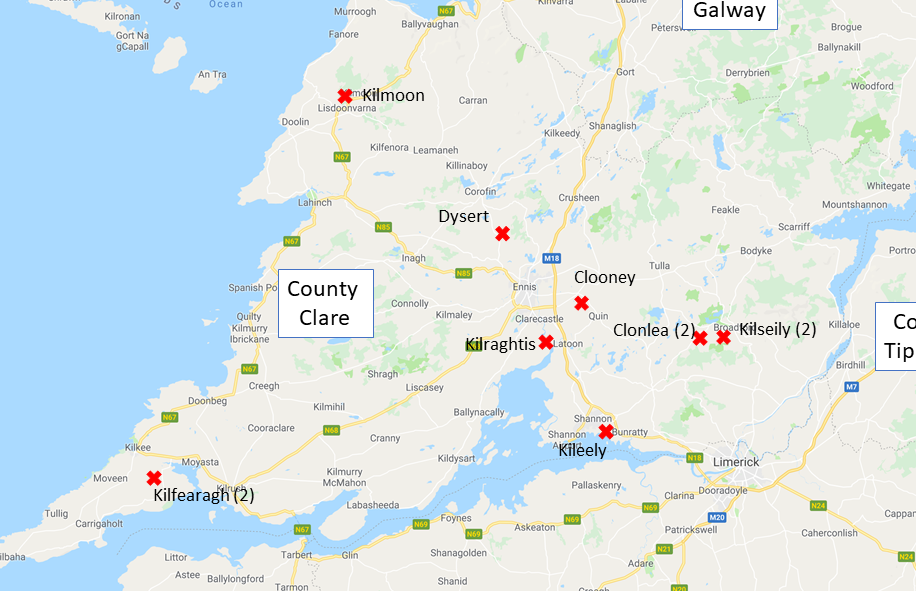
    So… where are all those James Fitzgeralds in County Clare? The red Xs in the image below.

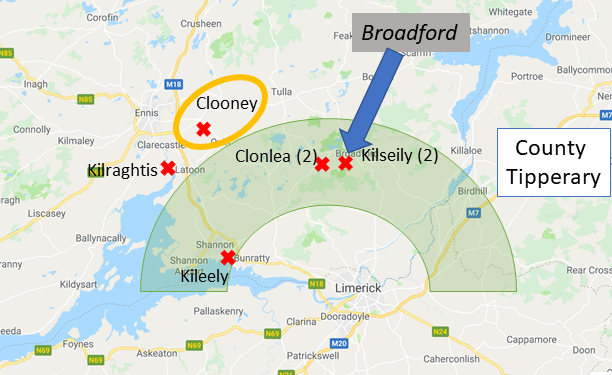
    That’s a lot of locations, but thankfully, stories passed down to my grandfather tell that James’ son was born about ten miles from Limerick, and that green band approximates five to fifteen miles from Limerick.

    Now, James’ son, Joseph, married a woman from the town of Broadford, which is 12 miles from Limerick, and considering how chain migrations work—people from one village in the old country often moved to the same neighborhoods in the new world—odds are good that Joseph was from Clonlea or Kilseily townlands near Broadford.

    Going great, right? I don’t necessarily even need to find a baptismal record for my Joseph around 1828. All I really need to find is one baptismal record in the right parish between say 1815 and 1840 where the parents are James and Catherine Fitzgerald and I’m golden.

    Unfortunately, I can’t find such a record. The best is for the 1834 and 1843 baptisms of Patrick and Bridget respectively, born to James Fitzgerald and Catherine Halpin from Clooney townland. That’s 20 miles from Limerick, not ten. Plus, family oral history notes that James and Catherine had boys named Mike and Tom, and we’re not seeing entries for those.

    So… another strategy I’ve found useful is to eliminate as many other people with the same name as I can. In other words, if I can figure out that all James Fitzgeralds from close to Limerick were not married to Catherines, then I can feel more confident about the Clooney record.

    I’ve looked in a bunch of different places, however, and… no joy. I can fill in the details of some of the couples, but not for the James Fitzgeralds close to Broadford.

    Why don’t I just accept this couple as my ancestors?

    The James and Catherine from Clooney townland just don’t meet my rules. I don’t have records for the same fact in both the U.S. and Ireland. I don’t have a clean townland match—if I’d found something close to Broadford, I would’ve taken it. And… I have to remember all those other James Fitzgeralds.

  • Probate: Guardianship isn’t about custody


    Probate documents are one of the best primary source documents, but they’re also one of the most complicated. Where I see the most confusion, though, is understanding guardianship, especially in Colonial and early Republic probate proceedings.

    If you want to dig deeper, I recommend spending some time at “Bob’s Genealogy Filing Cabinet” at genfiles.com, but here’s the quick overview. And actually, I’m going to start with a couple of quotes from that site’s Orphans & Guardians article, which really does a fantastic job of providing historical perspective.

    “For most of history an orphan was a fatherless child, irrespective of whether the mother was living.”

    “The guardian’s responsibility was focused on the property of the orphan [not] on the orphan himself… the primary purpose of a guardian was to provide for management of the orphan’s estate, and to use that estate for his maintenance and education… Guardianship thus had nothing to do with physical custody. Courts almost always assumed that orphaned children would live with their mother if she was alive and capable of rearing them.”

    Honestly, if you can internalize that, then you can stop watching this video. You’ve got the message. Of course, I have a few things to add, along with an example of how to misinterpret guardianship.

    First, pay close attention to when the courts assign guardians. Many courts will note in the record that a child was below or above a certain age. For probate proceedings taking place over many years, you can get very accurate estimates of when some of the children were born.

    Second, probate was a family affair. When courts assigned guardians, they typically chose close family members to play the role. As an example, I have been struggling for three years with the role of two brothers, Thomas and Joseph Chew as the guardians chosen by Nancy Chew Overman—I can’t figure out how Nancy was related to the two men, and the widely accepted genealogy puts Thomas and Joseph as siblings to a completely different Nancy Chew, which would have made Nancy Overman a fourth or fifth cousin.

    Third, realize how different education is today compared to a century ago. In 1919, only 17% of high school students graduated, which was nearly triple the rate of 1900. In 2016, 84% graduated high school.

    Go back to the 1800s? High schools didn’t really even exist. Education happened in a one-room school house that ended after the eighth grade.

    Go back even further to the colonial era, your education happened on the job, either from your parents or via an apprenticeship.

    For example, in colonial Pennsylvania, apprenticeship was such an important educational path that a 1713 law granted the courts the explicit power to place a minor orphan into an apprenticeship or other form of employment upon the request of a guardian.

    So… how not to treat guardianship. Here’s an excerpt from a genealogy of the Slough family in Pennsylvania. The story is that a wicked step-father banished his step children from their home and placed them into the care of guardians on nearby farms.

    You can already see the problem right there. The author equated guardianship with custody.

    What really happened is that when Philip Slough died intestate, his children were all minors, so the court assigned them guardians to protect their financial interests and represent them in court.

    I guess some of the older children could have been apprenticed out to nearby farms, but this would have been typical for the period. There’s no mention of apprenticeships in the probate file, though.

  • What to do if you can’t find a death certificate

    I’ve been looking at U.S. death certificates recently, noting that the genealogical information in them could be mistaken, depending on the person reporting that data.

    But what do you do if you can’t find a death certificate?
    Here are my recommendations:

    1. Check the website of the state health department for information on whether deaths were previously registered by counties.
    2. Use find-a-grave. Carefully.
    3. Check the newspaper, especially outside cities.
    4. Look for probate records.

    Before I get into this in any detail, though, let me ask you: do you really need your ancestor’s date of death? If you already have proof of their children and parents, you probably won’t gain anything. And if you’re looking for parents, you probably won’t find them on pre-1900 death registrations.

    The U.S. has a federal system, and that means an inconsistent mish-mash of death registration, especially from 1900 to about 1915, when most states adopted a standard form recommended by the Census Bureau, and centralized reporting from county and municipal control. Before about 1905, though, finding death registrations is the exception, not the rule.

    If you’re researching a death in the early 1900s, it’s worth visiting the website of your state’s health department. It will always list when the state began collecting records, and what to do if counties registered deaths prior to that. I’ve had mixed results here: most of the time, the counties will point me back to the state, but there are exceptions.

    Take Illinois: the state’s department of health website points you to county registrars for deaths prior to 1916. And for Illinois, you might just be in luck: DeKalb County, for example, sells these records online for a few bucks.

    What if county registrars don’t record earlier deaths? To use other sources effectively, you really need to be able to narrow things down to within a couple years and to a particular location. Find-a-grave is very good for this—you can get a year of death, possible even a date, and people were almost always buried close to where they died.

    I won’t go into Find-a-grave in detail—I have a set of videos about how to use that source—but here’s the quick version. Only rely on what’s carved into a tombstone. Everything else on a memorial is submitted by a user, and you can’t know the quality of their research. Still, assume good intent and take other info as a starting point.

    Another great source are newspapers death notices and obituaries. I’ve got a distinct video on how to track down newspaper resources, but here’s a quick summary. The United States used to be a nation of newspapers. Just about every town had one, and all of them earned revenue from death notices. The smaller the town, the smaller the newspaper, the more affordable the death notice, the greater chance for genealogical detail in the notice.

    Same went for obituaries—big city papers might only publish obituaries for leading luminaries and the most sensational deaths, but the press in little town might cover more.

    Your final best bet is to find probate documents. That’s a pretty complicated topic, though, so I’ll leave that to another video as well. Again, you’re going to need a county and a year, but don’t assume that probate will happen in the same place as death & burial. Trains made it possible to transport corpses, so a person could be buried in a different county or even state. Conversely, without trains, people were buried where they died, which might not have been where they lived.

    Let’s take a real example that wraps all of this up: my wife’s 2nd great-grandfather, Willard Harding. His tombstone in Mount Vernon, Washington notes that he died on 20 July 1907 at the age of 39.

    If you visit Washington Department of Health site, it states quite clearly that after 1 July 1907, the state collected death certificates. But they couldn’t find Willard’s. I followed the site’s direction to check with the county Auditor, but no luck there either. I followed a lead from a member of my wife’s family that he had died in Wentachee, and found an obituary index from the Wenatchee Genealogical society.

    When I got my hands on the articles, I got the whole story: Willard had been nearly bedridden for two years, and had visited Soap Lake in Grant County, which was a big health spa at the time. He became seriously ill on the train home, and was pulled off in Wenatchee where he died. His body was then shipped home to Skagit County.

    Why wasn’t there a death certificate? Maybe there was confusion over which county was supposed to record his death? Or maybe the Wenatchee doctor wasn’t even aware of the new law?

    Willard knew he was dying, so he made out his will at the age of 38. That will was probated in Skagit County.

  • Primary Sources: Finding stories in US Death Certificates

    In my last post/video, I looked at U.S. death certificates, pointing out that the genealogical information therein could have mistakes, depending on the person reporting that data. In this post/video, I’m looking at other areas of U.S. death certificates that you should pay close attention to.

    First off, cause of death. Most of the time, it’s going to be something common such as myocardial infarction, but occasionally you’ll find some interesting stories.

    Sometimes, you’ll encounter a dated explanation, such as Pthisis or Apoplexy. It’s always worth running a web search to discover the modern variants—Pthisis is tuberculosis, while apoplexy is a stroke. I had one 2nd great uncle, Michael Gallagher, who was in his mid-twenties when he died in 1904. His death certificate read “general paralysis” as the cause of death. I dug in a bit, and discovered that was a term for late stage syphilis. I can only imagine how scandalized his widowed, Irish Catholic mother and siblings were.

    Even better is the rare cause of death that could lead to stories in the local newspaper. My wife knew that her 2nd great-grandmother, Minnie Plummer, was killed by her own son in 1929, but no one in the family had the whole story—my wife’s great-grandmother wasn’t forthcoming about the story, for obvious reasons.

    When we saw that her cause of death was “strangulation by son” and that the medical examiner could only guess when she had died, we realized we had a shocking murder in the tiny farming village of Crofton, Nebraska. I immediately searched for a repository for the local papers, and found they had covered the story extensively, listing all the gruesome details of the murder-suicide. None of it was pleasant, but the raw emotion of it transformed Minnie and her kids from a few dry, unrelatable facts on old documents into living, breathing people.

    Second, check where someone died. This goes back to my principle of reading everything. Again, most of the time, there’s not going to be anything interesting here—people tend to die at home. But sometimes… take a look at Emmett O’Neill’s death certificate. His place of death was the Hamburg State Sanatorium, and it was stamped rather than handwritten. So was Emmett’s cause of death: “tuberculosis of the lungs.” The 33-year-old spent 11 months dying in a state hospital, over ninety miles from his wife and three young boys.

  • Primary Sources: US Death Certificates


    Primary sources are the documents that genealogists strive to find because they are created contemporaneously with a given event. But that doesn’t always mean they’re correct. You have to understand how the document is created, by whom, and for what purpose, to assess the accuracy of its information.

    Death records in the U.S. are spotty prior to the early 1900s. The Massachusetts Bay Colony started civil registration of deaths in 1632, but by 1851, only seven states were systematically recording deaths. In 1880 the country began to systematically collect causes of death for health purposes, but until the Census Bureau created a standard death registration form in the late 1890s that you started seeing a lot of death certificates with genealogical value beyond location, date and cause of death.

    By 1910, death certificates in the U.S. are pretty consistent in terms of format and content, and only a few places weren’t collecting them everywhere.

    It’s important to remember, however, that death certificates were initially created to track public health issues, not to help you identify your ancestors. Later, they became legal documents as well, used for probate, insurance and other reasons.
    Despite being legal documents, you can’t trust everything on a death certificate. Remember to think of a document as a conversation, and in this case, it’s a three-way with a medical professional, an undertaker and a reporter—typically a family member—all contributing to different parts of the document.

    Let me give you an example: When my father passed away in 2005, the gentlemen running Kimble Funeral Home took care of everything, including filling out the death certificate. They were responsible for parts of it, noting that my dad was cremated. They partnered with his doctor to note his date and cause of death. And about three hours after my dad died—when my mother and I were still in shock from watching him take his last breaths—they asked us where and when he was born, who his parents were, and whether he had any aliases. We didn’t have to present any documents to back that up either.

    In short, the part of a death certificate which notes cause of death, place of burial, and place of death is hard fact. The portion with genealogical information such parents, date of birth, and place of birth is completely reliant on the family member who was present when the certificate was filled out.

    Consider my father’s grandfather, Patrick Valentine O’Neill. His wife, Mary Haggerty O’Neill, reported his death, including a birth date of Valentine’s Day 1877. In fact, Patrick was born on 8 February 1877, and baptized on 13 February 1877, a day before St. Valentine’s day. His wife had the facts wrong.

    Not a big deal, just a few days off. Maybe Patrick’s middle name played a part, in that he remembered his parents telling him about being named after St. Valentine because he was born around that date.

    But consider Mary Haggerty O’Neill’s aunt, Catherine Tuohy née Haggerty. When she passed away on 12 Jan 1922, her son, Henry, reported that she was born on 7 Feb 1850 to George Haggerty and Catherine Merriman. Henry had everything correct except for his maternal grandmother’s surname: it was Gallagher, not Merriman.

    The Philadelphia Archdiocese has a 7 February 1850 birth of George Haggerty and Catherine Gallagher’s daughter, Catherine; as well as the 7 November 1875 record of an Edward Tuohy marrying Catherine, the daughter of George Haggerty and Catherine Gallagher.
    Henry was stressed: his mother had died of pneumonia at 1:50 a.m. He was probably exhausted, up all night, and he… well, he mixed up his maternal grandparents (George Haggerty and Catherine Gallagher) with his paternal grandparents (Edward Tuohy and Mary Meriman). Look again at Catherine’s death certificate—the name Edward was scribbled out, replaced with George Haggerty.
    When you look at a U.S. death certificate, pay close attention to the family member who reported the death. Who were they? What was their state of mind that day?

    If you have a close relative reporting the death, the parents and date/place of birth are probably correct. But if something on the cert doesn’t make sense, it could just be the result of a very bad day.

  • My core principles for genealogy research

    I’m mapping out what I hope will be a long-running Youtube channel about genealogy, and that’s making me think about the core principles that I try to follow when researching my kids’ ancestors.
    I’ve got four:

    1. It’s not about the information in the document, it’s about the people who filled out the document.
    2. Don’t rely on the transcription. Always look at the original image and read everything.
    3. Assume good intent, but know that everyone, including you, makes mistakes.
    4. Primary sources such as parish records are gold. Secondary and tertiary sources—that is, research conducted by others—are roadmaps to help find primary sources.

    Each document is a conversation

    For the first… you’ll find a lot of guidance about how to interpret census records, parish records, birth certificates. Each bit of guidance is different, because each document is different and has different potential errors. That’s how I started learning genealogy, but over the years, I’ve realized that’s not overly complicated, it doesn’t help me get started when I encounter a new source.

    There’s a simpler way. All of these documents aren’t the point. The point is that a conversation happened between at least two people, and the document reflects that conversation. The issue is the motivations and mindsets of the people having that conversation.

    That may sound weird, but consider, as an example, a census record. It may look like an “official” government document, but it’s really not. One person, a census taker, is filling out a document by having a face-to-face conversation with at least one other person who resides at a particular house or apartment.

    Consider the census taker first. This was a paying job, and census takers in the U.S. were paid by the head for completely filled out entries. They weren’t paid for getting every single detail correct, whether it was checking spelling on names or getting the right age. But they would go back to a house multiple times until they found someone at home.

    Then consider the family member who responded—and you can’t know which one. It could have been a wife who lied about her age because she was embarrassed she was older than her husband. It could have been a teenager who didn’t really know where her parents were born. Perhaps a grandmother from the old country who didn’t speak English well? Or consider a family scandal, where a mother in her fifties reported that her eldest daughter’s baby, born out of wedlock, was the daughter’s sister.

    Read everything

    Of course, there’s at least one more party involved, and this brings me to my second principle: read everything on the original document. The third party involved in a census record is a recent transcriber employed by a genealogy company. They’re doing their best, and will have far more experience than you and me deciphering these records generally, but from time to time, they’re going to mess up the obscure spelling of a name in your family.

    Additionally, they’re not always paid to transcribe everything, especially when you get to civil registration documents, parish registers, and the like. So I always, always look at the image. And it’s not just about transcription errors: I’ve found previously unknown relatives by reading additional information in immigration records, and discovered fascinating stories in causes of death on death certificates—such as the fellow who died of general paralysis, a euphemism for syphilis; and the woman whose cause of death was “strangulation by son.”

    Assume good intent

    You’ve made mistakes when researching your family tree, right? I know I have, and I know that I wasn’t just trying to concoct a fun story, I was just trying to get it right. I had good intensions.

    Portions of your family tree will already have been researched by others, and they will make mistakes as well. Perhaps there was a family legend connecting them to someone famous, and they only looked for facts that would support the legend. Or they got combined two people of the same name of about the same age who both lived close to each other. They might even have been conducting their researching a century ago, when the few available records could lead to the wrong conclusion.

    Those other family historians are just like you and me. They made mistakes, but those mistakes were all well intentioned.
    What does that mean? Don’t accept prior research at face value, but don’t throw it away either. Use it as a roadmap to trace their steps and double check their work. It’s not just about discovering mistakes—they may not have noticed some other juicy tidbit when looking at the same records.

    Rely only on primary sources

    This actually leads right into my fourth principle: the foundation of your work should come from primary source documents.
    What are primary source documents? They are created contemporaneously with a given event, for example, a census record, a baptism recorded in a parish register, or an intestate probate proceeding.

    Secondary sources are detailed prior research with extensive citations, such as a publish family history book; while tertiary sources are summaries, such DAR lineage books.

    Now, this may seem pretty obvious, but quite a few genealogy websites display secondary and tertiary sources in the same fashion as primary source documents. Take the Millenium File on Ancestry.com. It shows up as hints just like census and parish records, and a new user (such as me back in 2011) might assume it’s a totally reliable source. But if you read Ancestry’s card describing the source, it’s pretty clear that it is a tertiary source: a database of research compiled by others with no supporting citations. Ancestry even states that “Database like these are great starting points for beginning your research.”

    Don’t make the mistake of dismissing Ancestry’s entire catalog entitled “Stories, Memories and Histories” though. Some of these are primary source documents, such as county histories published around the turn of the 20th century. Those entries are based on first-person interviews, and the interviewee paid for their inclusion.