Category: Genealogy
-
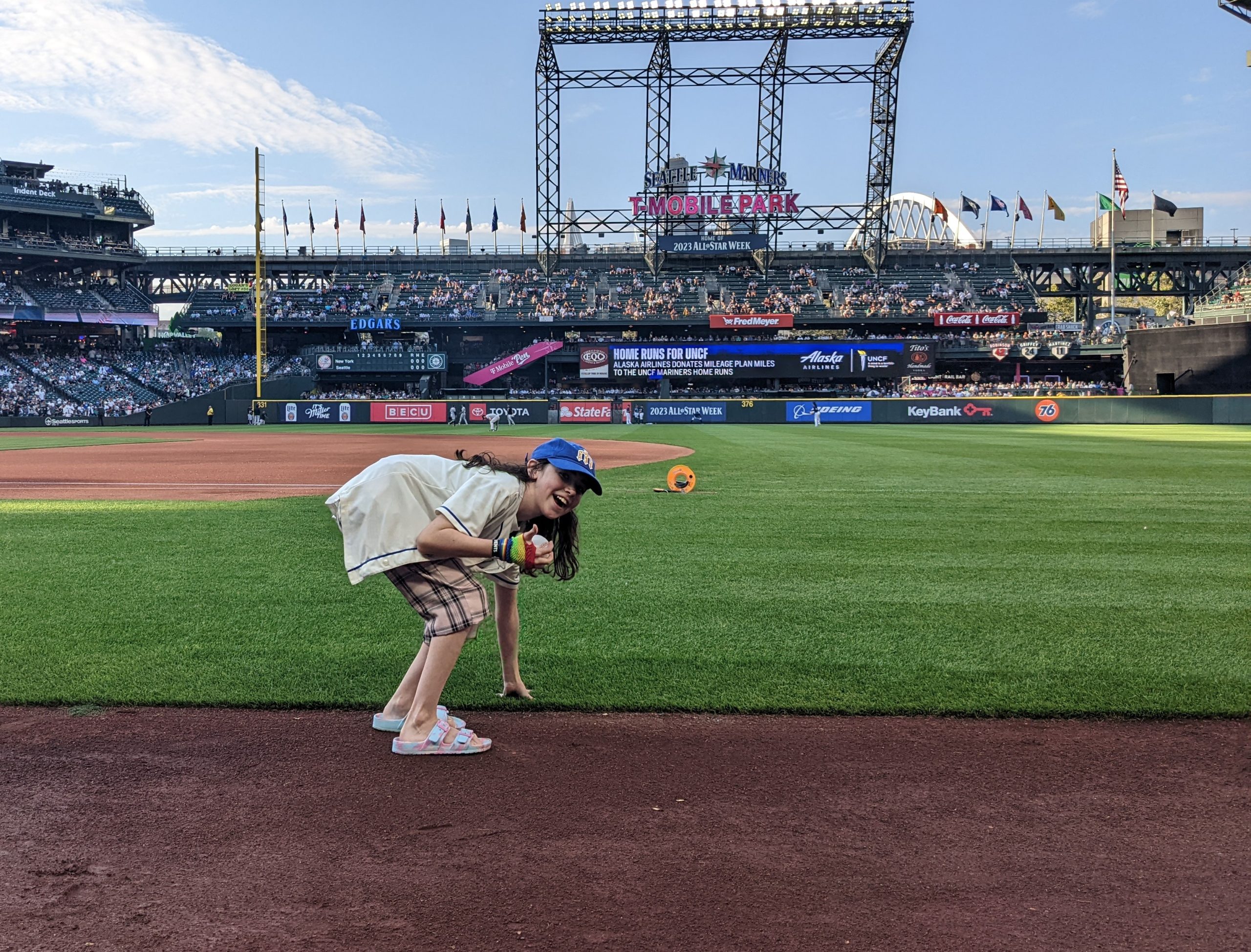
Mariners Tunnel Team

Touching the grass! 
Quinn getting an autograph from Mitch Haniger 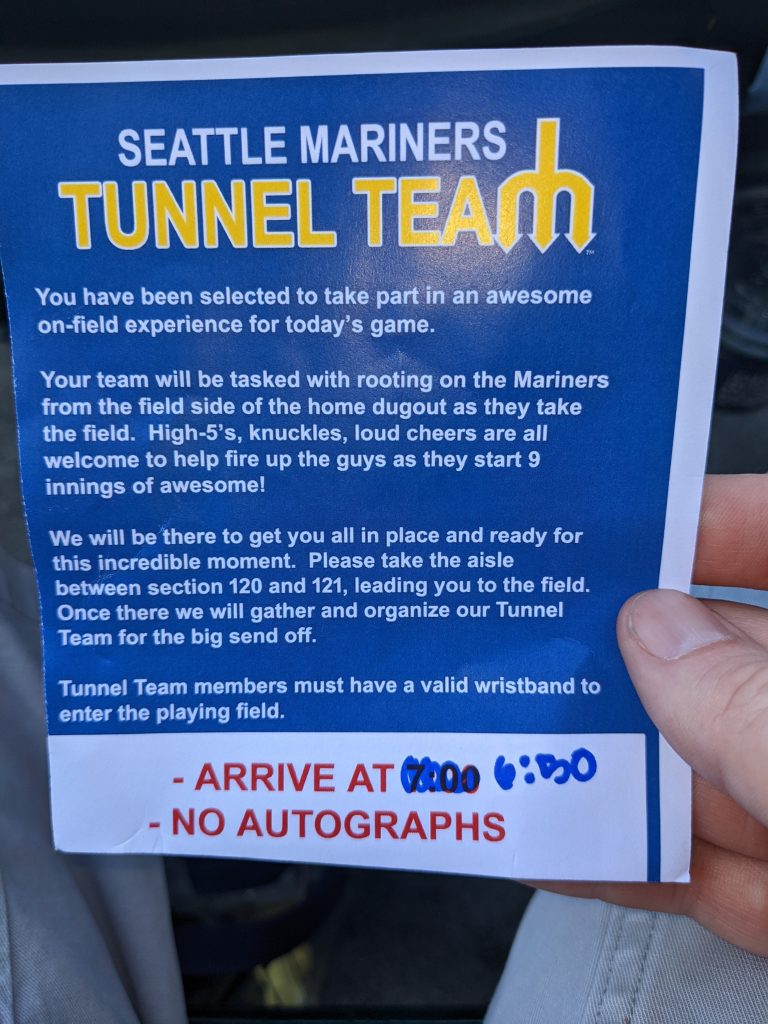
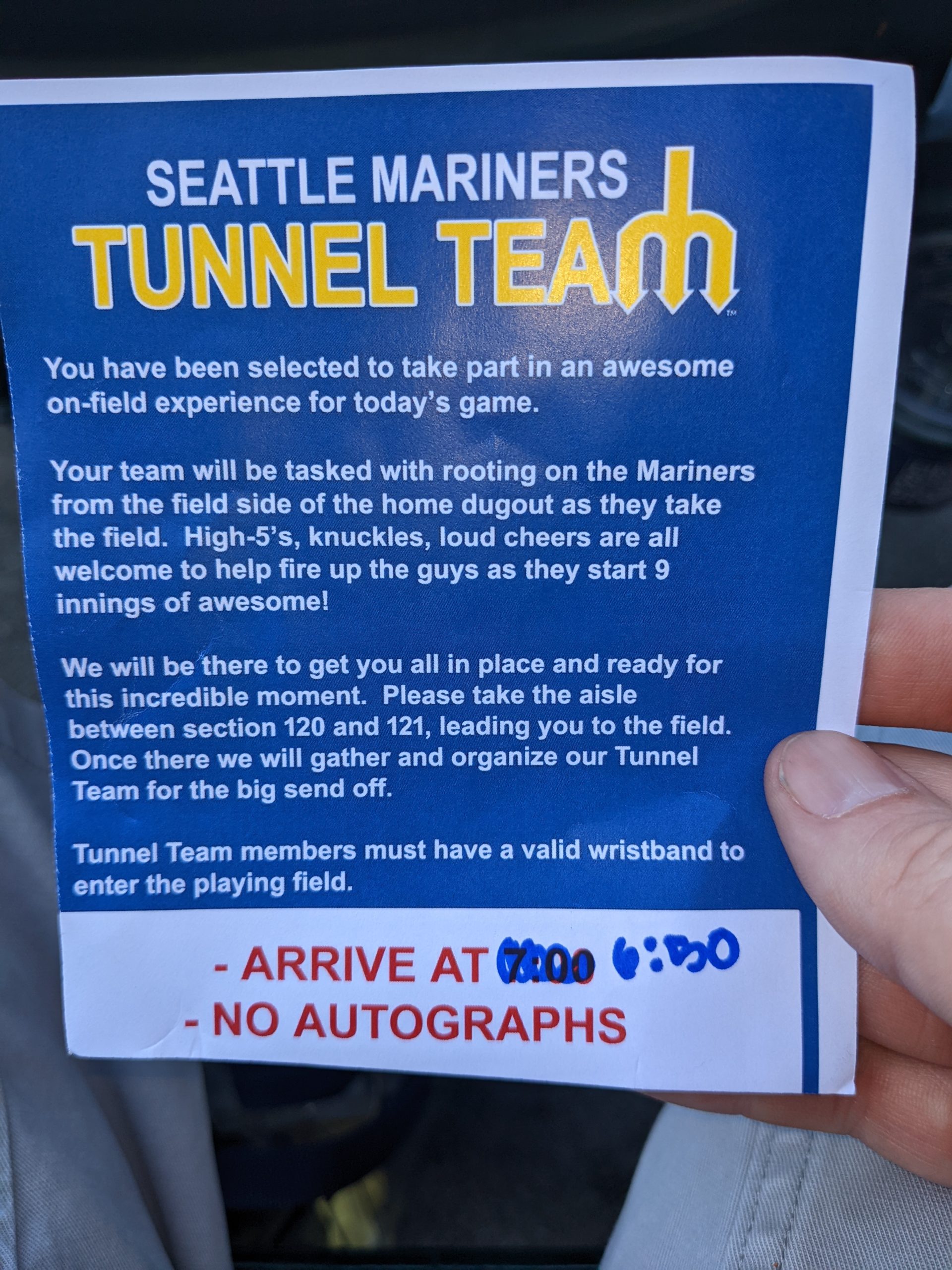
The instructions 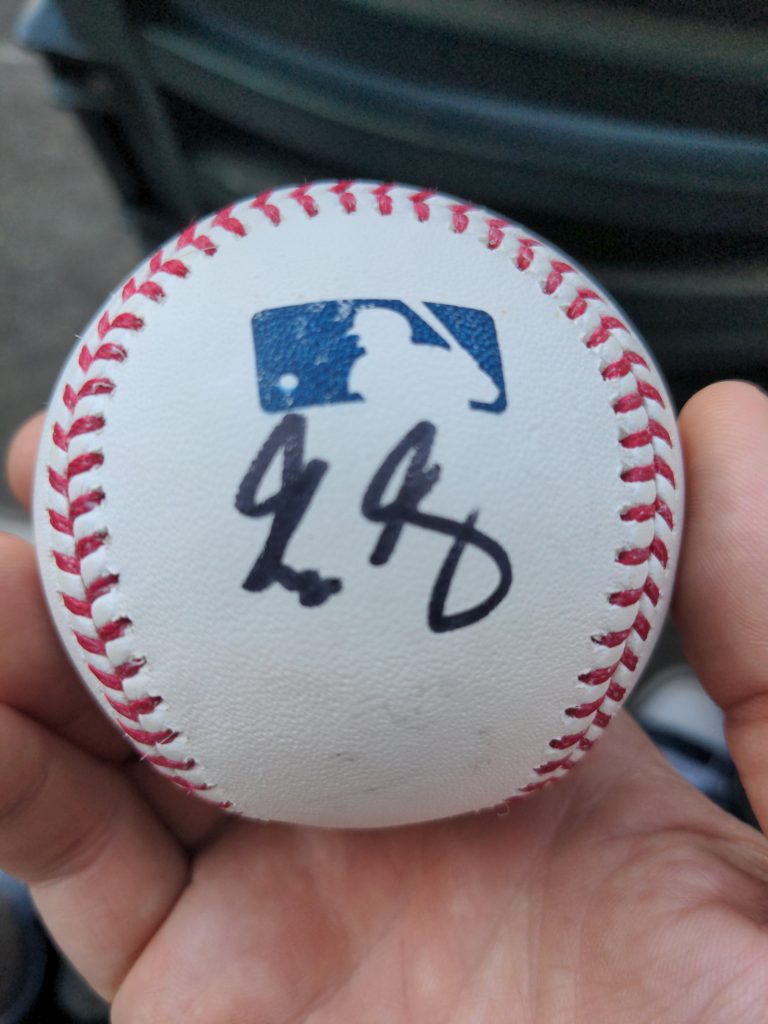
And a George Kirby auto to boot -
Did your female ancestor really get married in her teens?
Did you ancestor really get married at age 16? Probably not.
Here’s the quick version:
- Mean and median ages at first marriage are pretty consistent for the past few centuries: women in their early twenties, men in their mid to late twenties.
- Laws banning marriage below a certain age without parental consent also go back centuries.
- If you really think it happened, there’s probably an interesting story. Look deeper.
When I started researching genealogy, I had the impression that, a hundred or more years ago, everybody got married in their teens. And I definitely encountered some female ancestors where this appeared to have happened—especially in the mid-1800s, when U.S. census records started naming every person.
But in nearly every single case, something else was happening. Perhaps the marrying teen was actually a second wife who just happened to have the same name as the first wife’s. Or the child whose age suggested a teenage marriage was actually a nephew or niece. Or the young wife’s birth year was mis-transcribed. It could be any number of reasonable explanations.
Let me give you an example. In Jeremiah Van Fleet’s 1858 will, he named a daughter, Phebe Simon who was born in 1815. Jeremiah’s wife, Margaret, is well documented, and was born in 1796, meaning she was just 19 when her first child was born, and so probably 18 when she got married.
But… there’s this gap in birth years. The first child born in 1815 when Margaret was nineteen, the second in 1821 when she was twenty-five.
What really happened is that Margaret was Jeremiah’s second wife. His first wife was Phebe’s mother died, and she died sometime before 1821. In that year, Jeremiah married twenty-five-year-old Margaret.
My rule of thumb now is, from the 1600s to the 1960s, when genealogical records are reasonably extant, that women married at age 20 at their earliest, while the earliest age for men was mid-twenties. Anything earlier than that, I’m going to take a very close look.
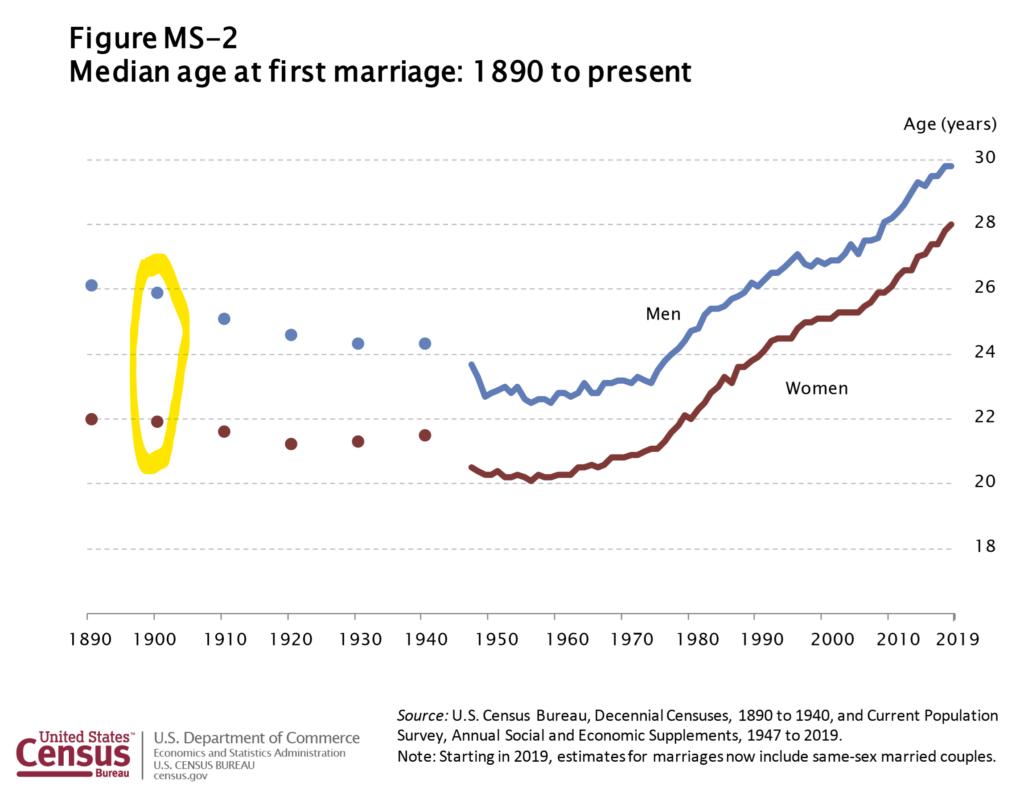
I believe the numbers support this rule of thumb. For example, the U.S. Census Bureau reports that the median age at first marriage age in that period ranged from 20 to 22 for women, and 23 to 26 for men.
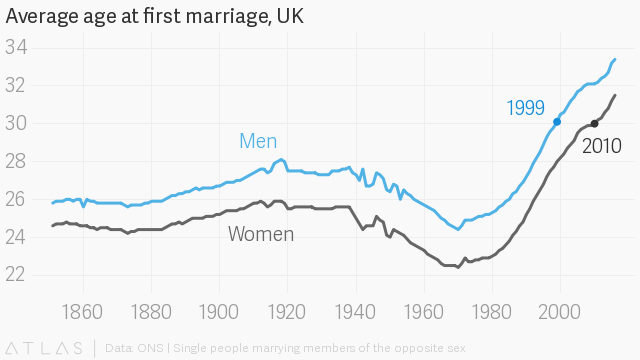
Average first marriage ages in England and Wales are pretty similar over the same time period, ranging from 22 to 25 for women, and 25 to 28 for men.
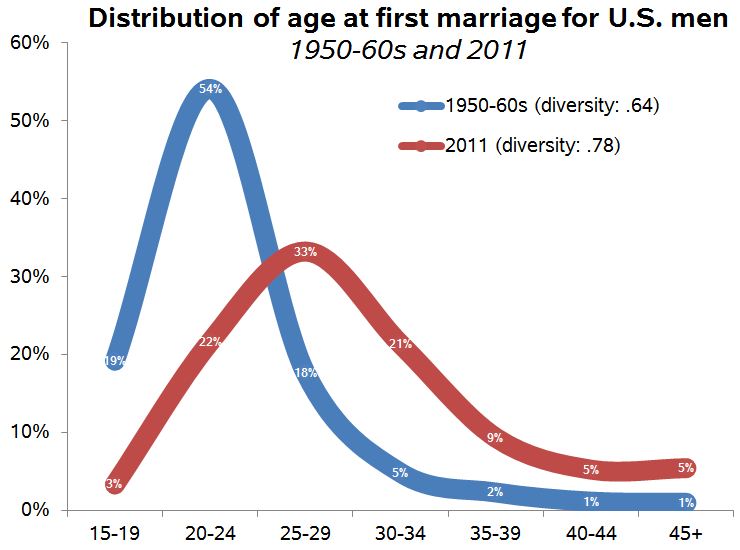
Averages and medians are different statistics, of course, but considering the likely shape of the data—skewed to the left by puberty and with a long tail to the right as shown in this chart—it’s mathematically expected that the long tail would pull averages above the 50th percentile. This makes the U.S. and U.K. numbers pretty much identical.
So what about marriages before the mid- to late-1800s?
Nation states and census data are sort of like, well… a horse and carriage. The two just go together. I mean, you really can’t have one without the other!
Nation states are a relatively new phenomenon and finding detailed marriage statistics prior to the mid-1800s isn’t just a simple web search.
My go-to source on colonial north American culture, David Hackett Fischer’s Albion’s Seed, helps to fill in the gaps, and does so in a pretty big way.
The book mostly covers the 1600s and 1700s, and documents five different ranges for age at first marriage for five different cultures:
- For Quakers in Pennsylvania, marriage ages approached modern levels, ranging from 26 to 32 for men, and 23 to 30 for women.
- Pennsylvania Dutch had similar patterns, with men marrying at an average of 29, and women at 26 for the research communities.
- For Yankee Puritans, the average marriage age was 23 for women, for men 26.
- In the Tidewater of Virginia, Delaware and Maryland, the average for men was also 26, but for women, it dipped down to between 18 and 20.
- Backcountry marriages amongst the Scotch Irish followed Tidewater patterns for women, with average marriage at 19 for women, and 21 for men.
These cultural norms weren’t new to North America: they were brought from Britain by their communities.
If most women were between 19 and 25 when they first married in the 1700s, a range which basically matched that of the 1900s; and men ranging from 22 to 26 in both periods; then we have a pretty durable range of first marriage over several hundred years.
So what do you do when you see a woman marrying at age 14, or a man at 18? Be skeptical. Odds are, you’re missing something.
The first thing to do is look for parental consent: it might take a while, but you can generally find a site that will tell you what the laws were, and if there’s a law, you can bet there are (or at least were) records, like this note signed by Andrew Chew regarding his daughter Mary’s marriage to Thomas Moon. Nothing in it says she was underage, but other sources say she was seventeen.
If you can’t find proof of consent—and even if you can—keep looking. There’s often a better story.
A good example from my wife’s tree is Harriet Elizabeth Pierson, who, at age 15, married a man nearly twice her age in 1833.
Why would she marry at such an early age? Well, first off, she was an orphan in an age when the concept of adoption did not exist. Orphans were expected to work, and a Cinderella-like existence was entirely possible.
There’s no record of parental consent—something her guardian could have withheld. It’s possible he did consent and the records are simply lost—we only know the details of their marriage from documents recorded decades later in Oregon.
But there was also something special about where Harriet was living. Western New York in the early 1800s was referred to as the Burned Over district, a place of fervent religious activity, a place where the second Great Awakening birthed several new Christian sects, including Jehovah’s Witnesses, Shakers and the Church of Jesus Christ of Latter Day Saints.
During the Second Great Awakening, it’s easy to imagine such legal niceties could have been glossed over. And it surely had a big impact on Harriet’s life, well beyond a potential legal and culture flexibility about a teenager getting married.
-
Why your Scotch-Irish ancestors moved so frequently
Do you have ancestors who move frequently but not far? Say, showing up in 1790s Shelby County, Kentucky, then Bullitt County in 1800, then Grayson County in 1810? Or perhaps Hamilton County, Ohio in the late 1790s then Montgomery County in 1803 and finally Darke County in 1810?
There are two factual scenarios at play here:
Fist, your ancestors stayed in place but the map changed: that’s what happened in my Ohio example. I covered this in a previous video, check it out.
Second, your ancestors really did move a lot. But why did that family move so frequently when another family in your tree stayed put for decades?
I want to thank Karla York for suggesting this as a topic for a video. She was responding to a comment where I noted that ethnic German immigrants to the United States practiced a crop rotation strategy which kept their land productive and fertile, while Scotch-Irish backcountry pioneers would farm a patch of land for a few years until it was deprived of nitrogen, and then move on to the next.
To be honest, that story is something my mother has told me for years, not something I had researched. Turns out it’s true, but it was just one factor in why some of your ancestors made lots of little moves.
What really drove this, I think, was culture, specifically Scotch-Irish culture, and specifically in the geographical region dubbed Greater Appalachia where the Scotch-Irish settled.
By culture I mean how people lived their lives, from marriage and sex, to how you built your house, to what you cooked. It’s the stuff you learn from your parents and your community about how to survive.
My favorite author on colonial culture, David Hackett Fischer, summarized Scotch-Irish culture in my favorite book on colonial culture, Albion’s Seed this way:
The [Scotch-Irish] were a restless people who carried their migratory ways from Britain to America… The history of these people was a long series of removals—from England to Scotland, from Scotland to Ireland, from Ireland to Pennsylvania, from Pennsylvania to Carolina…
Fischer cites the example of the village of Fintray: between 1696 and 1701, three-quarters of the population turned over. The same pattern showed up in Appalachian Virginia, where 80% of the people living in Lunenburg County in 1750 were gone by 1769, with half of that movement occurring between 1764 and 1769. Fischer asserts that “these rates of movement were exceptional by eighteenth-century standards.”
Those migrations, in both the borderlands between England and Scotland, and in the colonial backcountry, were short-distance, “as families search for slightly better living conditions. Frequent removals were encouraged by low levels of property-owning.”
A folk-saying from the southern highlands gives you a better idea of how people felt. “When I get ready to move, I just shut the door, call the dogs and start.”
That feels pretty extraordinary. What will you eat? How could you just walk away from your labor investment in crops? What about your tools, your plow?
The answer is culture once again. The Scotch-Irish weren’t farmers the way we might think of colonial farming, with acre after acre of corn and wheat. They combined livestock herding with vegetable gardens and some grain. And they didn’t have a lot of tools: Fischer cites an early 1700s primary source that colonial backcountry Scotch-Irish had “one axe, one broad hoe and one narrow hoe.”
When you picked up and moved, you packed up some produce, a few tools, and then herded your livestock a few miles to a new spot. In Scotland, it was sheep, in the colonial backcountry, pigs or cattle.
Of course, it wasn’t quite so unplanned as it sounds. In The Monongalia Story a history of one region of West Virginia, Earl Core wrote that:
“A small group of men might come in winter or early spring, build their first cabins, clear and fence their little fields, plant potatoes, corn, beans and pumpkins. After the crops were well started… the men would ride their horses back [to their family’s current residence], again load them with [the rest of their possessions], and return with their family.”
The collaborative nature of this migration shouldn’t be discounted. American culture lionizes the rugged individualist pushing back the frontier, but that was a myth. Frontier migrations were a community affair, and the greater the distance, or the deeper into the territory of another culture that would try to repel what to them was an invasion, the more critical it was to band together.
Fischer notes that the first settlements in Tennessee and Kentucky were centered around military-like forts and stations, where settlers living nearby could retreat for mutual defense.
Core noted that the forts were also the center of the community, where “young couples danced and courted, where marriages were performed and funerals held, where land claims were recorded and justice meted out.”
As the native populations were pushed out & settler control secured, the Scotch-Irish spread out. As one North Carolina congressman put it, “no man ought to live so near another as to hear his neighbor’s dog bark.”
There’s only so much I can pack into a video of less than five minutes. If you want to learn more, get a copy of Albion’s Seed. It’s dense and long, but I think it’s worth it.
So… what of the bit about the Scotch-Irish moving because they wore out the land? It’s a bit of a chicken-and-egg scenario, isn’t it? If your culture is to move frequently, you didn’t need to maintain the fertility of your land.
The Scotch-Irish did have a way to re-fertilize land, however. Fischer quoted a traveler to the southern backcountry who noted “A fresh piece of ground… will not bear tobacco past two or three years unless cow-penned; for they manure their ground by keeping their cattle… within hurdles, which they remove when they have sufficiently dunged one spot.
-
Why did you accept that hint? A new ancestry.com feature.
Will you look at this? Ancestry.com is asking me why I accepted a hint. Or ignored it. Or said “maybe.”
I have the “beta features” flag turned on for ancestry.com. Despite working in the tech sector, I’m not really an early adopter, but I’ve been so frustrated with ancestry’s service (and with all my brick walls) that I figured it was worth getting to the bleeding edge.
I haven’t seen an announcement for this, but this feels huge to me.
My gut is that ancestry.com is evaluating its hint model—which is at least partially driven by one user adding a record to a profile that matches one of the profiles in my tree. That model assumes that all user input is accurate, when we all know that’s not true.
The short-hand for folks like me in the data analytics world is the phrase “garbage in, garbage out.” If your dataset is garbage, your analysis will be garbage.
Asking questions such as these might just provide ancestry.com a data source to evaluate user contributions, possibly even use machine learning to assess the validity of hints.
For example, clicking that “I want to save and review later” is an easy indicator for ancestry’s algorithm to say “meh, don’t pay attention to this.”
Not selecting anything at all—which I suspect most ancestry.com users would do—would effectively provide the model the same answer: Don’t pay attention to this user’s input.
Response rate could also give ancestry.com a way to score their users: those that are committed to helping ancestry.com understand their data could potentially be given a higher weighting in a more modern hint algorithm. More important, it could help identify careless researchers, and limit their ability to muddy the waters.
Of course, this begs the question of whether ancestry.com should change their baseline assumption: that the central task in genealogy research is finding someone who’s already researched it.
I’m more intrigued by the behavioral side of it, though: by asking these questions, will users reconsider accepting an ancestry.com hint? Will people ask themselves “Is it just a name? Do that dates really match? Did I check the other people in the record?”
There are drawbacks, of course. Take this photo hint for George Rautzhong. It’s a photo of his tombstone, and I have chosen not to attach these to profiles.
I have two main reasons why I won’t attach a piece of evidence. First is that I don’t like the source—it might be a tertiary source, or just a picture I don’t care about. Second, I just don’t care about the profile: I mean, what do I gain from adding city directory entries for a sibling of my main line? Not much.
Ancestry.com has made an erroneous assumption that people will care equally about all the profiles in their tree.
I’ve been, at best, skeptical of the utility of ancestry.com’s features over the past year. But this tells me that great things could be on the way.