Tag: genealogy

  • Did your female ancestor really get married in her teens?

    Did you ancestor really get married at age 16? Probably not.

    Here’s the quick version:

    1. Mean and median ages at first marriage are pretty consistent for the past few centuries: women in their early twenties, men in their mid to late twenties.
    2. Laws banning marriage below a certain age without parental consent also go back centuries.
    3. If you really think it happened, there’s probably an interesting story. Look deeper.

    When I started researching genealogy, I had the impression that, a hundred or more years ago, everybody got married in their teens. And I definitely encountered some female ancestors where this appeared to have happened—especially in the mid-1800s, when U.S. census records started naming every person.

    But in nearly every single case, something else was happening. Perhaps the marrying teen was actually a second wife who just happened to have the same name as the first wife’s. Or the child whose age suggested a teenage marriage was actually a nephew or niece. Or the young wife’s birth year was mis-transcribed. It could be any number of reasonable explanations.

    Let me give you an example. In Jeremiah Van Fleet’s 1858 will, he named a daughter, Phebe Simon who was born in 1815. Jeremiah’s wife, Margaret, is well documented, and was born in 1796, meaning she was just 19 when her first child was born, and so probably 18 when she got married.

    But… there’s this gap in birth years. The first child born in 1815 when Margaret was nineteen, the second in 1821 when she was twenty-five.

    What really happened is that Margaret was Jeremiah’s second wife. His first wife was Phebe’s mother died, and she died sometime before 1821. In that year, Jeremiah married twenty-five-year-old Margaret.

    My rule of thumb now is, from the 1600s to the 1960s, when genealogical records are reasonably extant, that women married at age 20 at their earliest, while the earliest age for men was mid-twenties. Anything earlier than that, I’m going to take a very close look.

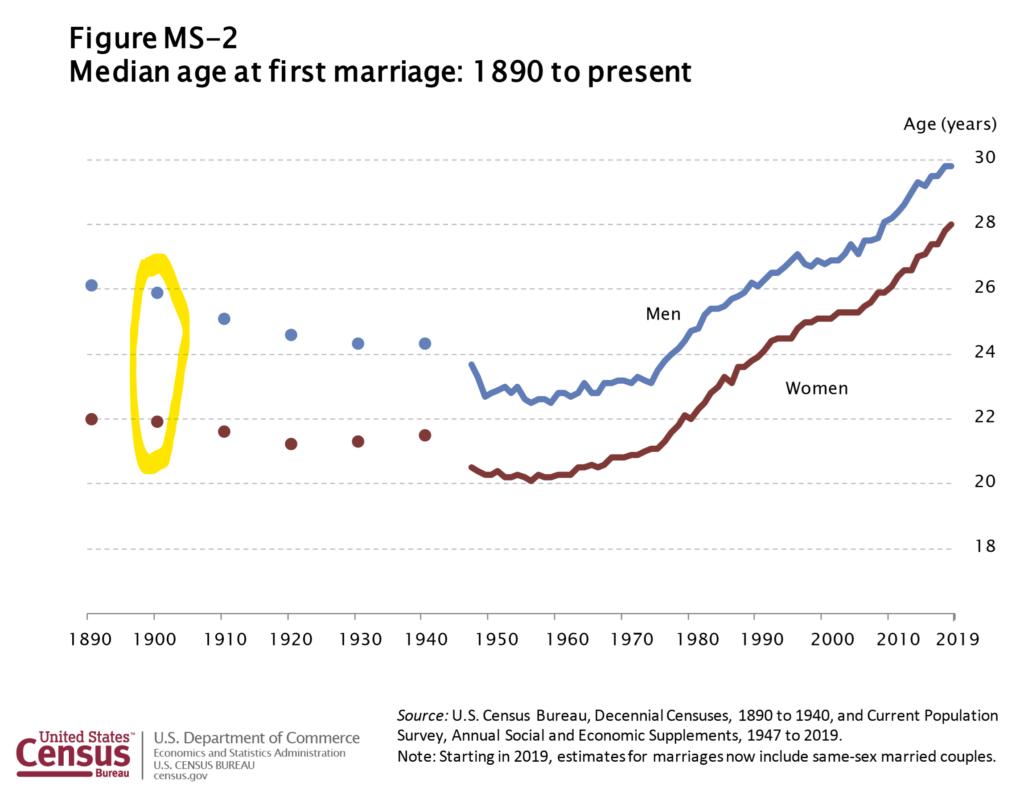
    I believe the numbers support this rule of thumb. For example, the U.S. Census Bureau reports that the median age at first marriage age in that period ranged from 20 to 22 for women, and 23 to 26 for men.
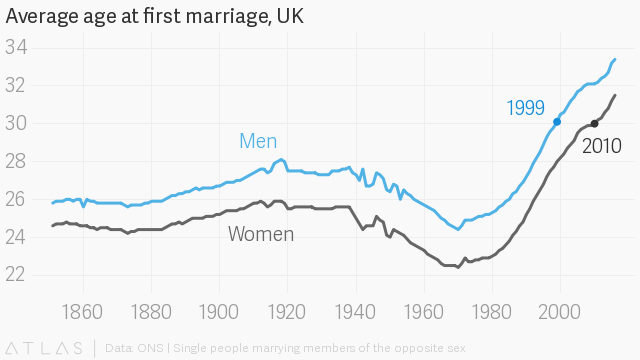
    Average first marriage ages in England and Wales are pretty similar over the same time period, ranging from 22 to 25 for women, and 25 to 28 for men.
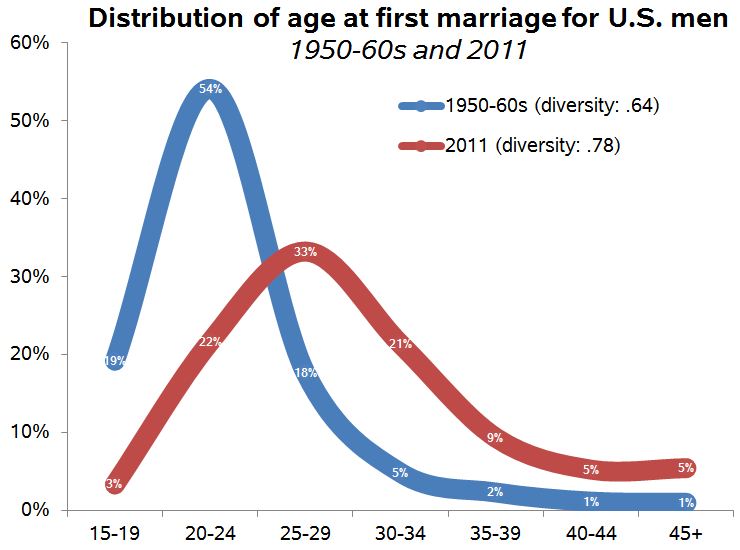
    Averages and medians are different statistics, of course, but considering the likely shape of the data—skewed to the left by puberty and with a long tail to the right as shown in this chart—it’s mathematically expected that the long tail would pull averages above the 50th percentile. This makes the U.S. and U.K. numbers pretty much identical.
    So what about marriages before the mid- to late-1800s?

    Nation states and census data are sort of like, well… a horse and carriage. The two just go together. I mean, you really can’t have one without the other!

    Nation states are a relatively new phenomenon and finding detailed marriage statistics prior to the mid-1800s isn’t just a simple web search.

    My go-to source on colonial north American culture, David Hackett Fischer’s Albion’s Seed, helps to fill in the gaps, and does so in a pretty big way.

    The book mostly covers the 1600s and 1700s, and documents five different ranges for age at first marriage for five different cultures:

    • For Quakers in Pennsylvania, marriage ages approached modern levels, ranging from 26 to 32 for men, and 23 to 30 for women.
    • Pennsylvania Dutch had similar patterns, with men marrying at an average of 29, and women at 26 for the research communities.
    • For Yankee Puritans, the average marriage age was 23 for women, for men 26.
    • In the Tidewater of Virginia, Delaware and Maryland, the average for men was also 26, but for women, it dipped down to between 18 and 20.
    • Backcountry marriages amongst the Scotch Irish followed Tidewater patterns for women, with average marriage at 19 for women, and 21 for men.

    These cultural norms weren’t new to North America: they were brought from Britain by their communities.

    If most women were between 19 and 25 when they first married in the 1700s, a range which basically matched that of the 1900s; and men ranging from 22 to 26 in both periods; then we have a pretty durable range of first marriage over several hundred years.

    So what do you do when you see a woman marrying at age 14, or a man at 18? Be skeptical. Odds are, you’re missing something.

    The first thing to do is look for parental consent: it might take a while, but you can generally find a site that will tell you what the laws were, and if there’s a law, you can bet there are (or at least were) records, like this note signed by Andrew Chew regarding his daughter Mary’s marriage to Thomas Moon. Nothing in it says she was underage, but other sources say she was seventeen.

    If you can’t find proof of consent—and even if you can—keep looking. There’s often a better story.

    A good example from my wife’s tree is Harriet Elizabeth Pierson, who, at age 15, married a man nearly twice her age in 1833.

    Why would she marry at such an early age? Well, first off, she was an orphan in an age when the concept of adoption did not exist. Orphans were expected to work, and a Cinderella-like existence was entirely possible.

    There’s no record of parental consent—something her guardian could have withheld. It’s possible he did consent and the records are simply lost—we only know the details of their marriage from documents recorded decades later in Oregon.

    But there was also something special about where Harriet was living. Western New York in the early 1800s was referred to as the Burned Over district, a place of fervent religious activity, a place where the second Great Awakening birthed several new Christian sects, including Jehovah’s Witnesses, Shakers and the Church of Jesus Christ of Latter Day Saints.

    During the Second Great Awakening, it’s easy to imagine such legal niceties could have been glossed over. And it surely had a big impact on Harriet’s life, well beyond a potential legal and culture flexibility about a teenager getting married.

  • Improving Ancestry com’s MyTreeTags feature

    I’ve been so focused on DNA ThruLines and the hints system that I didn’t notice Ancestry.com’s new tagging feature. Tags have been around a long time, and it’s nice that Ancestry.com added this capability.

    But… it seems a half-baked effort.

    1. There’s no obvious warning to other researchers when I flag something as unverified or a hypothesis.
    2. Ancestry isn’t helping me ignore the “old” method of using icons.
    3. Tags have no visual impact in tree view: for example, the “no children” tag doesn’t replace my “no children” gender neutral child on my tree.
    4. The “direct line” tag isn’t well thought out. Why can’t I just click myself and activate this along my direct line?

    My biggest beef is about the research tags.

    On a personal level, I’d love the research tags to appear in more places. One example: I complain a lot about ancestry.com’s poor hint quality, and I will go to “All Hints” page and ignore hundreds of hints for people I don’t care about. But I don’t always remember which profiles I stopped looking at because they’re brick walls. The research tags should appear next to the profile name here to remind me.

    But the biggest miss for research tags is communication to other genealogists. One of my biggest fears is that someone else will take a wild guess of mine and copy it. I have one hypothesis in my tree by the name of “Wild Speculation Chew.” And then after I discover my wild guess was wrong and remove it, someone else will copy the copy of my wild guess. And ten years later, there are dozens of trees with my random guess.

    Someone actually contacted me and made a joke about the crazy names they gave people back then.

     Add an example of family tree search and tags

    My second complaint is centered around how this feature feels like Ancestry.com is attempting to standardize all the crazy little hacks we all make to help track our research. But ancestry isn’t making an effort to help us ignore those little hacks now that there’s a better option.

    For example, I put question marks as the suffix of a person’s name when I’m not convinced I have the relationship right, and create a gender-unknown child named “No Children” when a person didn’t have any kids.

    Other people add little icons of angels and immigrant ships. I hate little icons. Well, no, I hate that ancestry serves up those icons as hints. I hate that so much I have a whole video about how easy it would be for ancestry.com to use artificial intelligence to categorize images, and give me the choice of suppressing hints for the image categories I don’t want to see.

    My third suggested area of improvements is visualizations for the tags. The central experience in ancestry.com, for me at least, is the tree view. Sometimes I start by searching for an individual, but at some point, I traverse my tree in tree view.

    Take a look at Thomas Kirk Plummer, here. I put some tags, but at a glance, all I can see is my ?. To see those tags, I have to click on his name and then expand the tags section.

    OK, that’s not too bad. But for standard, un-customizable tags, why not create an additional visualization that is immediately visible for a handful of tags?

    For example, research status tags could appear in on the right side of the profile pic, with unverified as a question mark, verified a check mark, hypothesis a light bulb, actively researching a magnifying glass, etc.

    No children could have a small stop sign at the bottom. A brick wall could have… well, a little brick wall across the top.

    My fourth area for improvement is about the “relationships” bucket of tags, specifically the “Direct Line” tag. That is just screaming out to me as a place for improvement.

    On my wife’s tree, for example, I can trace back to fifth-great grandparents on almost every branch. That’s 254 people to tag as “Direct Line” and at five clicks per person, that’s 1,270 clicks, just for my wife. And I have several other lines of ancestry, including my own. Really, I’m never going to use that tag. Too much work, too little value.

    But what if I could click my wife’s profile and choose an outline color for her direct line ancestry? Two to three clicks, and this could turn into this.

    Oh, and why colors? Because there’s a point in my wife’s family tree, ten generations back, where she intersects with my sister-in-law’s family tree. In that case, the square around their common tenth-great-grandparents could show both colors. And I did not realize they were distant cousins for months.

  • Why you should delete people from your tree

    Why do we keep all these people in our family trees?

    At one point, I had close to six thousand individuals in my public tree on ancestry.com. Some branches of my public tree were meticulously researched over many years, but others are merely copied from other trees, or represent basic, easy-to-reproduce research that I no longer maintain because I don’t really care about those people.

    When I look at a person in my public tree, I ask myself three questions:

    1. Am I making a significant contribution to the person or lineage?
    2. If I’m not making a big contribution, have I at least done enough due diligence to feel confident that the information on my tree is correct?
    3. If I haven’t done my due diligence, then do I really care about this person or lineage?

    If I can’t answer yes to at least one of those questions, I delete that person from my tree.

    Why? What harm is it to have some extra branches in my tree?

    Genealogy today is really a crowd-sourced exercise—we all borrow and rely upon the work of others, adding our unique contributions here and there. That means we copy errors from other trees, and errors in our tree can be copied elsewhere, magnifying the mistake.

    That’s the harm, and it is extremely difficulty to stop the spread of an error because… well, large parts of most trees are just copied, and the owners of those trees don’t really care about the branch with the error.

    More important, the repetition of the error can create an illusion of truth: the more times you see the erroneous lineage, the more likely you will believe it to be true.

    It’s all a bit of a vicious circle.

    My favorite example is a Pennsylvania Dutchman named George Slough. There were several men by that name, and thirty or forty years ago, a family researcher merged the George Slough who migrated to Pelham Ontario from Pennsylvania in the 1790s with a George Slough of about the same age who died unmarried and childless in Pennsylvania in 1759. It’s quite easy to prove they are different men, but with dozens of trees and a long-accepted genealogy, not a single person has modified their trees, even though I can provide an alternate lineage. A few have even been openly hostile to me.

    The same goes for supposition and educated guesses: given enough time, a guess can morph into fact.

    A great is George Harding, my wife’s purported 3rd great grandfather. Every tree I’ve seen on ancestry and familysearch list him as such along with a detailed lineage for him going back generations. I copied the entire thing but when I dug in more deeply months later, I couldn’t find any evidence that George or his parents even existed.

    Eventually, I traced the source for his existence—a genealogy researched in the 1970s which explicitly stated that the only evidence was a handwritten note on the fly-leaf of a book, and that researcher couldn’t find any further evidence. They even wrote that they hoped someone in the future would have better luck!

    Not a single tree recorded that this lineage was just a guess, and now that it’s been 40 years, it’s essentially become fact. That’s no help to anyone.

  • The DAR has tough-to-find genealogy resources

    Not every good genealogical resource is indexed and available from a major genealogy website, or orderable from the Family History Library, or requestable via inter-library loan. Sometimes you need to dig.

    Major genealogical societies and local historical societies are also useful repositories, and these groups often have niche sources that are too costly for the major websites to obtain.

    Most of the time, you won’t really know what these smaller repositories have unless you visit (or hire someone to visit for you). The Daughters of the American Revolution are an exception, and in this video, I’ll show you the resources you can obtain from that site.

    There are two main sources to look at in the DAR’s Genealogical Research System, or GRS.

    The first is the Genealogical Records Committee search or GRC search. As I understand it, the various DAR chapters around the country visit churches, graveyards, and other repositories to transcribe their registers. These are then reported in to DAR headquarters and indexed in the GRC.

    For example, I spent quite some time trying to prove that a Jeremiah Van Fleet from Ohio married a woman named Margaret Armstrong, but at the time, I couldn’t find any records to prove it.

    Searching for Jeremiah in the GRC, I get two results, one showing wedding records. If you click on the page number, you can see the other names on the page, and there’s a Margaret Armstrong. I ordered the report, and it confirmed that Jeremiah married Margaret Armstrong. Of course, it’s been five years, and that record is now easily available, but you get the idea.
    The second type of information is the Ancestor search which will get you secondary sources—genealogies with citations.

    You can also search for a particular ancestor: Let’s search for Bernard Slough—my wife’s lineage to him is how we got into the DAR. Start by clicking on this red tree icon: this will bring up a listing of genealogies the DAR has approved. The first item brings up my wife’s lineage starting with her great-grandmother. The second is that of another member.

    The third major option is purchase a copy of a DAR member’s application and any supplemental material. The DAR has tightened it’s standard of proof, so the most recent applications will have the most detail. 

    I recommend buying all the lineages and supporting documentation, but if you don’t want to spend that much cash, pick the lineage with the highest member number. Member numbers are assigned sequentially, so the higher the number, the more recent the application.

    And if you’re expecting to get your hands on the supplemental documentation, it’s really important to note that, prior to 1984, the DAR didn’t even retain a copy of supporting documentation. So make sure you’re ordering a recent application.