Category: Photography

  • Swimming with a Sea Lion

    25-JAN-11: Isla Isabela

    In the afternoon, we snorkeled in a bay on Isla Fernandina. The conditions and visibility were atrocious. I kept my head down under the water mainly to avoid looking at the scum floating on the surface. Oddly enough, I wasn’t bothered by my hair going through the muck, but watching Katie swim through it…

    Anyway, it was hard to see more than a few feet: we had to stay right next to the rocks, ahem, to the rock cliff to see anything. There weren’t many fish. A couple of stars. Not much to see at all, actually.
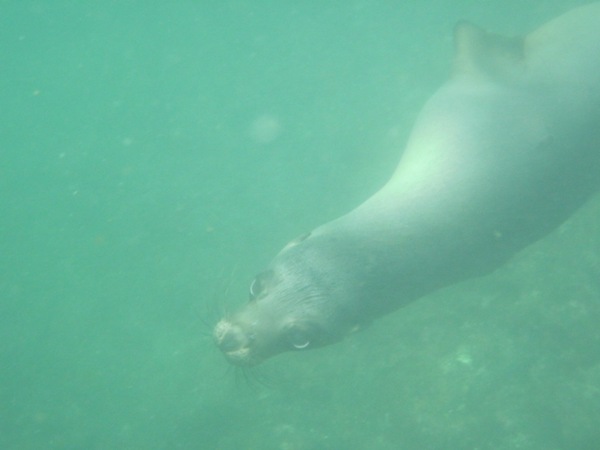
    2011-01-25 sealUntil I saw a sea lion dart directly underneath me. And then back in front of me. And around me. It was magic. I was checking out the sea lion, and it was checking out me. But the moment didn’t last long: there were other humans for the sea lion to investigate, and it disappeared in the green muck.

    A couple minutes later, I heard Katie shouting for me to get over to her. There was a Galapagos penguin swimming with us. By the time I swam over, it was out of the water and on a little ledge along the cliff. It and a friend were just hanging out, and Katie wanted me to take a picture of her near them. On impulse, the day before we left, we decided to purchase an underwater Canon point-and-shoot. I had trouble figuring out how to use it: button-to-shutter response just wasn’t as instant as with my 1d, and that meant I thought the shot was done when the shutter was still open. Yeah, it’s not like the shutter is open for very long, but if you move the camera when taking a shot, it’s going to be blurry. Add in the movement of the waves… I took three of Katie with the penguins, and only one wasn’t a modern painting of gray streaks. The one that did come out… metered badly. Blown out a bit.
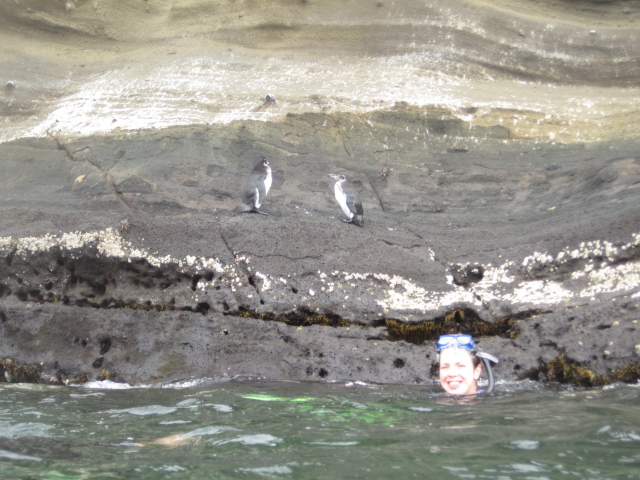
    2011-01-25 katieThat was it for the excitement, though. Someone called out they saw a sea turtle, but with visibility so low, you had to be right on top of it to see anything.

    I had a bit of a scare before the penguins, though: my right calf muscle suddenly cramped up into a tight, baseball-sized knot of pain. The rest of the time, I was swimming either with one leg, or just by moving my feet, rather than my legs. Thankfully, the pain in my right toe mostly subsided with all the salt water: all I got from the flipper rubbing against it was a dull ache. Cut right big toe, abrased left ankle, sore right calf muscle. What else could happen?
  • Don’t step on the iguanas

    25-JAN-11: Isla Fernandina

    Another long night of dozing, not sleeping as the Flamingo crawled about 150 miles west to Isla Fernandina; from the northeastern most island, to the far northwest of the archipelago.

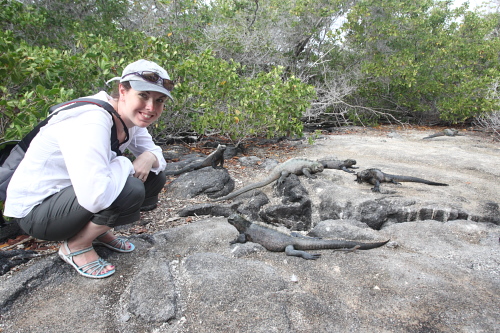
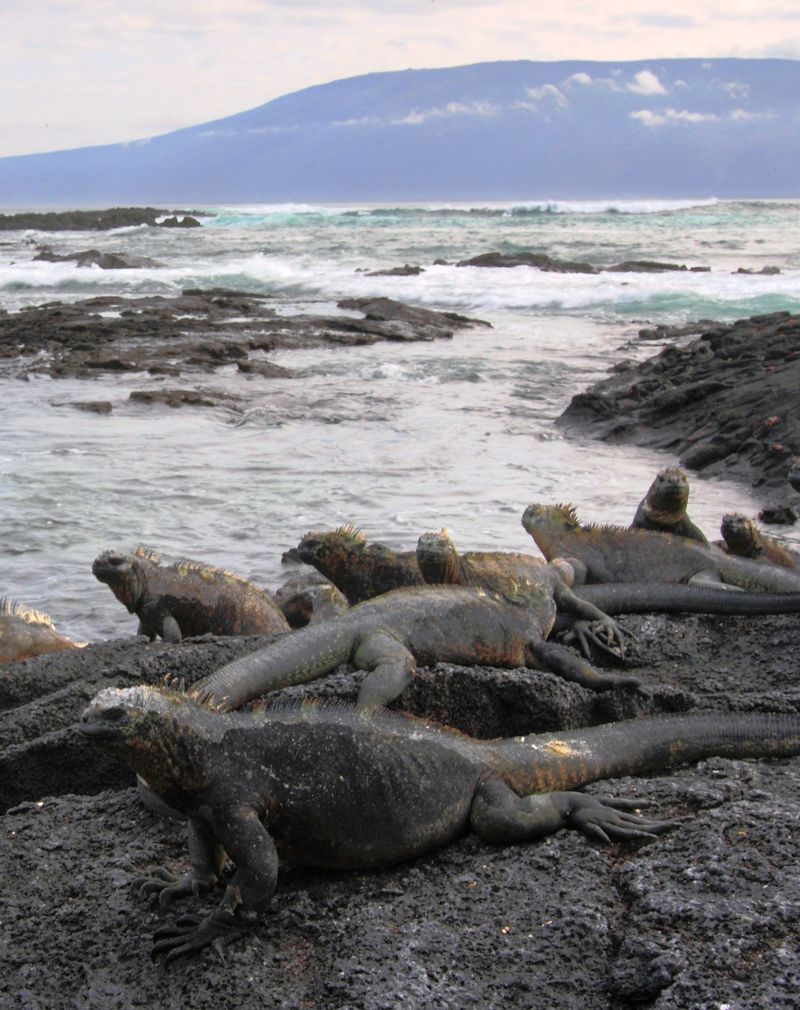
    2011-01-25 katie-iguanaWithin five feet of our landing point, there were six or seven iguanas sitting there amidst a tiny clearing in the mangrove trees. All the cameras came out, while Karina, our guide, attempted to tell us that the most important thing on this island was to not step on the iguanas, but that if you do, don’t freak out if they spit out you: it’s just salt water.

    Right, how could I step on an iguana? Yeah, they have camouflage, but… there can’t be that many.

    When we got out from the little clump of mangrove trees to the rocky coast, it was iguanas as far as the eye could see. Stepping on one? The challenge in some places was finding a place to step that didn’t already have an iguana resting there. There must have been a thousand little marine iguanas sitting motionless on the pahoehoe lava flows.

    I tried to take a landscape with the iguanas in the foreground, but it didn’t turn out well: black iguanas on black rock, white foam from waves, pale blue sky and white clouds… Either the mid- and back-ground was blown out, or the foreground was so dark you could barely distinguish the iguanas from the rock. I tried everything I could think of. A circular polarizer. A graduated neutral density filter. I probably needed a much stronger neutral density filter to fix that contrasty mess, though.

    2011-01-25 iguanasI also was struggling with my “tripod.” I didn’t bring my usual tripod, because it can be a hassle to handle, and it adds a ton of weight to my backpack. Also, with the subject matter of the Galapagos, I didn’t think I’d be taking many landscapes or sunset shots that’d require a tripod. A monopod should be enough to steady my hand for wildlife shots, and one of those twisty little “wrap-it-around-a-tree-limb” tripods would serve if I had any landscape opportunities (you want your camera close to the ground for those shots anyway. Anyway, the little thing was awkward to set up, and so low to the ground I could barely see through the viewfinder. All of my shots ended up a couple degrees askew from the horizon line.

    Meh. The shot above… I brightened up the shadows as much as I could, cropped out half the shot to make it a vertical landscape, and did a bunch of color adjustment to bring out the blue in the waves and the lighter brown on the backs of the iguanas. Still not a great shot. As I look at it, I think I would’ve done better to get way more iguanas in the foreground.

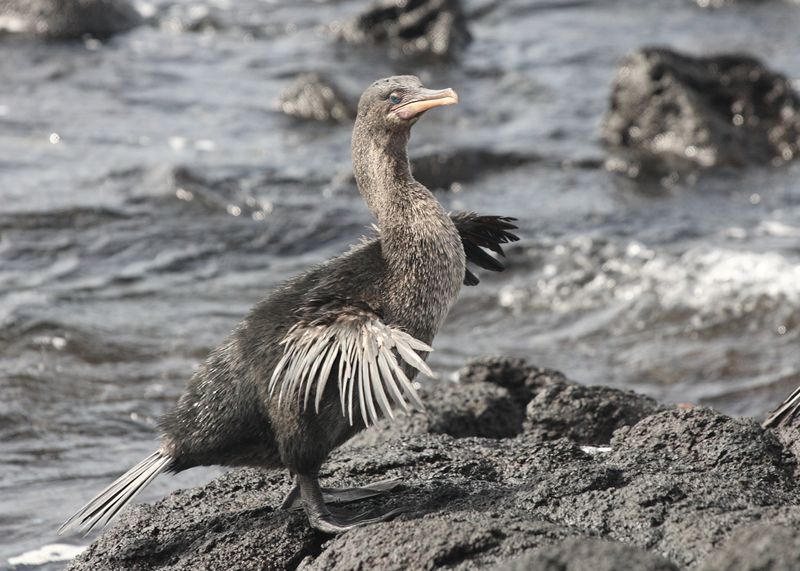
    The saving grace of the photographic day were the flightless cormorants. Further on in the walk, we came upon a group positioned such that the morning sun was behind my back, lighting up the cormorants beautifully. Then one popped out of the water, stood off by itself, and spread its stubby little wings out to dry. And every once in a while, it turned its head to catch the warmth of the morning sun, lighting the shot perfectly.

    2011-01-25 cormorant

    Panchito, the bartender gave me a couple band-aids the day before for my big toe. I went through two that morning, but with the strap of my sandal rubbing against the wound… by the end of the walk, I was limping along, resting my weight on my monopod like it was a cane, and wearing the sandal like a reverse flip-flop (the strap along the ankle the only one in use).

    I had another battery mishap: the shoulder strap on my camera suddenly came loose, and the camera landed on the battery casing. The impact was hard enough that the casing cracked and bent outward. Something tells me the weather seals were compromised. I hope it doesn’t rain when I’m out shooting.

  • Stupid Birds

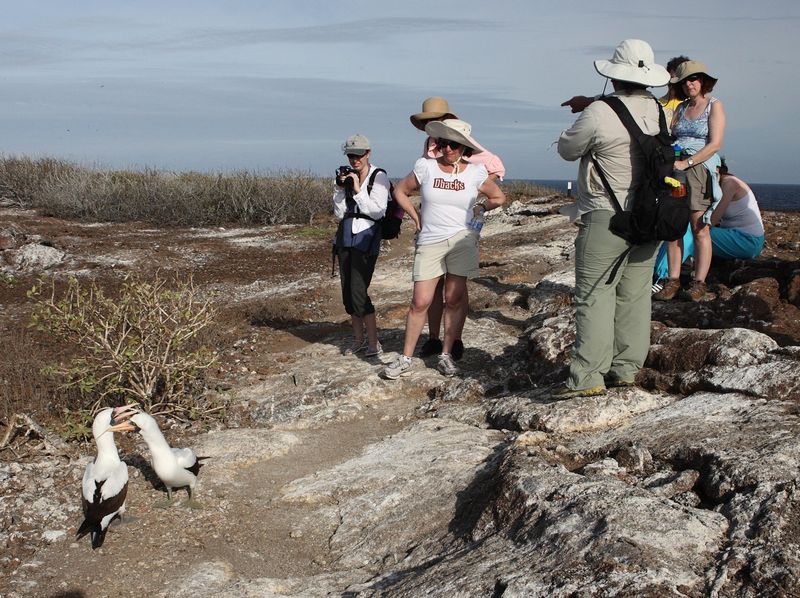
    2011-01-24 boobies and people

    24-JAN-11: Isla Genovesa

    Seriously. Just. Plain. Stupid.

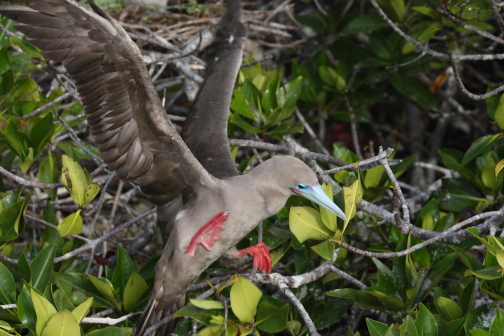
    This was my first reaction to the Nazca Boobies we encountered on Isla Genovesa. They were just standing there, on the ground, waddling like penguins and not moving when we got close. What bird doesn’t know to fly away when a human gets close, even if it’s just to hop into a tree or onto a rock just out of reach?2011-01-24 redfooted boobieWe saw a ton of birds today. Nazca Boobies. Red-footed Boobies. Great Frigate Birds. Mockingbirds. Lava Gulls. Swallow-tail Gulls. And they had no fear. Not a one.

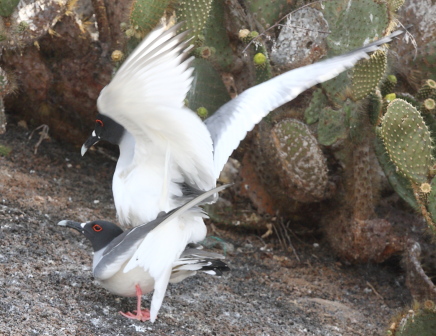
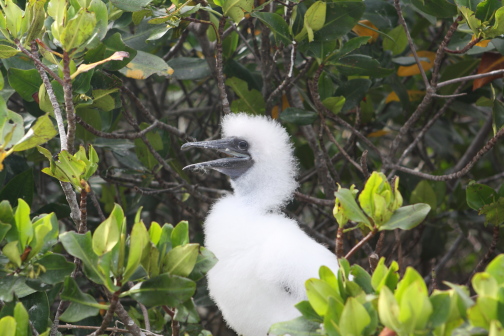
    2011-01-24 mating gullsWe saw a pair of Swallow-tail Gulls mating (right). We saw a ton of chicks, from ugly looking frigate bird chicks to these downy-white balls of cotton that would eventually mature into red-footed boobies.

    About halfway through the hike, my camera’s battery died. I couldn’t believe it. I had charged that thing the night of 22-JAN-11, and shot less than 200 frames on 23-JAN-11.  That battery used to last for 48 hours of intense shooting before it died. I guess after five years, I need a new battery. Katie lent me her camera for most of the rest of the walk.

    2011-01-24 baby boobieWhile taking a shot of one of the red-footed booby chicks, I lost my balance and scraped my left ankle badly enough that it was bright red with blood. That wasn’t enough to stop me trying to get that same shot again (the chick was probably seven feet above sea level, and this one steep rock put my head about eight feet above sea level) and I lost my balance a second time, this time cutting my big toe on my right foot pretty badly, enough for it to actually bleed and me to feel nauseous about ten minutes after. The cuts were surprisingly deep and razor straight; a reminder that the rocks are glass-sharp lava formations.

    I handed Katie back her camera after I felt nauseous. I wasn’t about to take any more shots.

    The cuts made it increasingly hard to walk with my sandals on, and the thought of participating in the next activity—snorkeling—with fresh cuts was not appealing. We went kayaking for an hour or so, which was a relaxing alternative, even if salt water kept dripping from my oar onto my wounds.

  • My Fourth of July

    Yeah, it’s a long time after the fact, but this was my Fourth of July, just a few blocks from my house.Fireworks_spaceneedle

  • Day 4: Olympic NP Workshop

    Last day, and not even a full day shooting so people have time to travel.

    David left the decision for our last subject up to the group. It was an overcast day, so the Elwha River valley (where I went on Day 0, and the group went briefly on Day 1) was one choice. But David felt the clouds might just be a low-lying marine layer of fog, and that Hurricane Ridge just might be clear. Layla–a native of British Columbia–agreed. Peter wanted Elwha, and the entire class was with him. I had this feeling about Hurricane Ridge, though. A really, really strong feeling. And my ride, Peter, was adamant… in his friendly, easy-going way.

    I decided to take the risk of riding up the mountains on my own. I say risk, because Patrick had to change his… jets, or something… at 4,000 feet and then 8,000 feet on the Scooter Cannonball this past spring. I didn’t know if my little Vespa would just lose power at high altitude. Worst case scenario: I would have to turn around. Bad case scenario: I’d have to hike the last little bit. A worthwhile risk.

    OK, it wasn’t just the jets or whatever. The previous two times we went up Hurricane Ridge, it was hella cold. I was going to be a human popsicle by the time I reached the top, and that isn’t conducive to photography.

    Layla and David were right: it was just a marine layer. But there was a second marine layer a good thousand feet above Mt. Olympus, so the sky was fairly flat. I took a few pictures, including this panorama. It’s a technique Peter mentioned involving stitching together multiple pics. I have software that does this (poorly) but I’d never thought of actually trying it (like all pictures in my blog, just click to enlarge).
    Panorama

    But mainly, I was uninspired again.

    Until I spied two deer walking across the meadow. There was my foreground. Considering how docile deer in Olympic NP were the past two days, I knew I could get within ten feet of them, maybe closer, without upsetting them at all. The approach was painful. I had to walk slowly, not only to avoid spooking the deer, but to make sure that I didn’t step on any of the delicate little plants and flowers just starting to sprout.

    Deer_olympicsI took a ridiculous number of shots: with deep green firs on the mountainsides contrasting with wispy white clouds and a pale blue sky resting atop snow covered peaks, getting a balanced picture was next to impossible, so I needed to hedge my bets with lots of shots at lots of different f-stops. I even ditched the circular polarizer for a graduated neutral-density filter that darkened a third of the picture (the sky in this case) by about half-a-stop, balancing things a little bit better.

    Deer_olympics_herd Eventually, the pair of deer moved on, but as I was packing up my gear to head back down, I spied an entire herd. Not only that, but they were grazing on one side of a ravine and in front of a clump of pine trees. A much more interesting foreground than the flat, brown-green meadow the first pair were wandering through. I took a ludicrous number of shots. Oddly enough, though, the larger number of deer made the picture far less pleasing. There was too much going on. The best, I believe, is the one above, of the two deer, walking, crossing from snow to meadow. Any thoughts?

    I stopped, but this time, it wasn’t because the deer had walked away. Over the past two hours–from 8am to 10am–the temperature had risen so much that I was pouring sweat under the heavy jacket and sweater I was wearing to avoid becoming a human popsicle. I actually used the electrical hand-dryer in the ranger station’s bathroom to dry off my t-shirt.

    Creek_green_island On the way down, I thought I spotted Peter’s rental car by Heart of the Hills campground right near the camp entrance, so I pulled over. I followed the sound of water, and low-and-behold, there were Peter and Layla and another fellow whose name I had forgotten. Not only did this give me one more chance to say goodbye to Peter and Layla, but I got this shot.

    By then, I was done. I stopped by Dungeness National Wildlife Refugee on the way back, but it was stale and lacking in wildlife beyond birds (which are impossible to photograph without a 600mm lens).

    Instead of taking 101, I decided to take back roads as much as possible. It lengthened the ride and increased my exhaustion, but it was far more pleasurable. Roosevelt_elkAnd I spied a herd of Roosevelt Elk that, according to my Olympic NP map, are "much shier than those elk you may find further east; it is unlikely that you will see any while you are in the park." No joke. All I needed to do was stop my scooter 100 yards from them, and they clumped together and started to move away. I waited patiently, but the best I could manage was this–a distant shot with an ugly background. 

  • Day 3: Olympic NP Workshop

    I had grand plans to be up at 4am to scoot up to Hurrican Ridge to catch the sunrise. The plans didn’t last. It was tough enough to drag myself out of bed at 5:45am for the regular 6:45am pickup. Like yesterday, Peter and Layla arrived at the exact same time I did. Couldn’t have worked out better.

    We were the last up the ridge, which was fine with us.

    Hurricane_ridge The light was flat, the mountains dark, the clouds thin and whitening the whole pale, pale blue sky. I bought a graduated neutral density for just this reason–to darken the sky so my camera could handle the sharp contrasts. I forgot to use it.

    Another tough subject. No foreground, constrasty subject. My hopes for this trip was to get one great shot I could use for my Christmas cards this year. But I’m beginning to despair of a great shot. I’ll settle with learning some great new techniques and getting some nice, but not stellar shots.

    Peter, Layla and I were the first to leave the ridge, which was fine with us.

    Forget_me_not It wasn’t even 9am, and our afternoon subject would begin at 12:30pm. On the way down, we ran into some deer, which consumed a bit of time. After that, my first thought as navigator was to head to the harbor for some reflections. But it was windy (no reflections), so we headed back to the Marymere Falls trailhead from Day 1, this time to focus on Lake Crescent. Peter stopped us on the way to shoot some forget-me-nots, which eventually pulled me in, too.

    Tongue Point was our 12:30 appointment, and for once on this trip, we had a challenging subject that yielded some good shots, with a lot of work. The weather wasn’t fighting us, the Starfishsubject wasn’t foreign to me. Not that I had ever shot tidal pools before, but close-up/detail work and color are things with which I’m familiar. But we did have to work: the entire path was encrusted with barnacles and shells and slippery slimy kelp. Our subjects–anemones, starfish, etc.–were hidden in cracks and crevices, behind kelp and rocks.

    Low tide was 2pm, and a few moments after that, someone told me that a cluster of serving-bowl-sized, multi-colored starfish were clumped together right where the waves were coming in. I was entranced, so much so, that I didn’t realize the tide was coming in until my right boot was almost entirely underwater.

    Capella_3 Next, the harbor again. I wandered a bit, but was bored, and when two boat-owners engaged me in conversation, I put my camera aside and began chatting. They gave me a tip: a 1920s wooden sailboat originally commissioned and owned by prize fighter Jack Dempsey was up in drydock for repairs. I went up to the repair shop, started chatting up the workers, and soon enough, I was talking to the Capella‘s new owner. I didn’t really get any interesting shots, but it was fun to wander the drydock during working hours with permission.

    Not much after that, though. Sunset was back at Ediz Hook, but the most memorable moments were the local reporter, the crazy lady telling us how to get the best shots, and the conversation I had with one workshop participant about Microsoft’s fantastic ability to burn money like fuel (he’s a Microsoft partner).

    Tomorrow, we meet at 7am for one last morning destination, and then the workshop is over. Tough, frustrating, but a good challenge.

  • Day 2: Olympic NP Workshop

    S_path We got off to an early start to a long day. First destination: Sol Duc forest, about ten miles west of the main part of Olympic NP. Peter, Layla and I were on the road early, and when we arrived, only David was at the trailhead.

    I came here to learn how to photograph forests and landscapes. Part of this hike was Sol Duc falls, the other was the forest–David’s favorite, apparently, and the main reason he has come back to the Olympic Peninsula for twenty-two years. Anyway, I haven’t figured out forests yet. I got the s-curve thing (photo right), but that’s general. I tried everything, and it was all lame.

    Fungal_droplets The falls was a nice distraction, and I got some nice shots. And I had some fun with these tiny water droplets somehow frozen on the underside of a fungus.

    Just as the sun was coming out, making the forest nearly impossible to shoot with stark highlights and shadows, David (with Layla) found me to give us both some tips. I didn’t get to practice, but I want to write it down for next time.

    1. Hide trees behind trees. You’re trying to simplify the chaos of the forest.
    2. Find a few trees in a row, ideally in perspective to lead the viewer into the forest. They don’t have to be in a line, actually, but they should be at different distances.
    3. Use at least one tree as a vertical frame, even cut the trunk in half.
    4. Don’t bother finding the tops of the trees. It’ll just wash out the picture.
    5. Find leading lines.
    6. Generally, you’re trying to make the viewer feel like they can step right into the forest through your picture.

    Anyway, I’ll remember this for later.

    Next destination: Rialto Beach, on the Pacific Coast. The lighting was bleak, flat. Gray clouds, no texture, dirty gray/brown water. Blech.

    Propane_tankLayla and I walked about twenty minutes down the beach to "hole in the wall," an arch at the far end of the beach. Photographically dull, but a beautiful hike. On the way back, we figured we should find some subjects to shoot. A rusted propane tank was the target. The pictures all sucked, but we were getting tired, and trying David’s landscape technique with the propane tank as our foreground was hilariously funny. By the time we had walked back, though, our legs were weak from keeping a sure footing on the pebbles and rocks that made up 75% of the beach. I had planned to stay until sunset, but by the time I reached the parking lot, I was done. Peter had been ready to go for an hour, so we took off immediately.

    When we got back, I rallied to make a trip out to Ediz Hook for the sunset there. It was flat. Pretty to watch, bland to photograph.

    This has been a very challenging workshop. 

  • Day 1: Olympic NP Workshop

    Rain.

    Marymere_falls_2The day started well enough: cloudy, but dry. I drove out with Peter (a former 20th Century Fox exec) and Layla (a student from Victoria) to Marymere Falls, just west of Olympic NP. David, our instructor, joked that there was always one person who pounded out to the Falls, photographed, and was back in the parking lot before he had even managed to start up the trail with the final stragglers. This would be me.

    The point was not the waterfall, I kept reminding myself. The point was the forest and the moss. Which is good: I’ve got the whole waterfall thing down. Narrow aperture, low ISO, super-slow exposure, and about a half stop up from the automatic meter. The camera always meters against the white of the water, leaving the greens of the moss and blacks of the rocks blacked out. Hmmm. Actually, the meter on my new digital body always tries to take shots as if it were midday, no matter the lighting, necessitating a full stop down instead.

    Curled_stump_2Still, easy. The only challenges with Marymere falls was the huge amount of mist which blurred out half my shots. And the supposedly "washed out" trail right up by the falls. I was the first to ignore the warning signs and walk down the trail.

    But the forest. That was hard. And as I started heading back, eyeing the forest, it started to rain. Just a little. Then a little more. Then a lot. Pouring. I don’t know if I even managed anything good. To the right is the best I got. But this is why I’m here.

    After lunch, the plan was to head up to Hurricane Ridge. Peeking_deerWeather was still crap, but there was a slim chance that, if we went high enough, we could get up over the cloud layer. We did get over the cloud layer. The first cloud layer. The second, higher cloud layer wasn’t raining. It was snowing. Big thick flakes, and as we got higher, they began to stick. We turned around. It was a useless trip.

    Though we did run into some incredibly tame deer. I must’ve been within ten feet of one buck before I decided I was getting too close. Best shot there: this one of a fawn peeking from outside a shrub.

  • Day 0: Olympic NP Workshop

    Madison_creek3 Today was Day 0 of the Olympic NP Workshop led by David Middleton.

    Day 0 meaning, I thought everyone would get in Friday evening, and we’d be shooting today. No such luck. Workshop’s first meeting was this evening. There are sixteen of us, I think, only one other is in my age range. Actually, I think she’s younger than me, probably 20s. But everyone else is 50s or older. No strenuous hikes on this trip. Which, considering how slammed I was after my activities this morning, it’s probably a good thing.

    I sent David an email before the workshop, asking for recommendations for my free Saturday. He suggested I check out Lake Crescent and/or the Elwha River if it’s cloudy, or the harbor if it’s sunny. I figured I hit all three, but after the long ride yesterday, and some strenuous hikes with huge amounts of gear, I only hit two of the three waterfalls along the Elwha River I’d planned to hit.

    Wolf_creek_falls The experience was daunting: I’ve never been that good of a nature photographer. I try, but having lived in, well, Chicago, San Francisco and Manhattan since I left home at 18, I’m a city boy. Urban photography, people, seems to work better for me, even though I want to take the beautiful nature shots.

    Anyway, I can get the waterfalls. I’m good with the waterfalls. The killer, though, was the photo to the left. I had to jump creeks to get to it, but just as I was about to head back, I caught a glimpse, just above the falls, of another waterfall. I couldn’t see much of it, but gods, it looked magnificent.

    And no way to get there without climbing gear, or major bodily injury.

    A good day, though.

  • eBay Amusement

    It’s all about the last few seconds.

    I have been trying to buy a Canon L-Series f2.8 16-35mm wide-angle lens. The going price used is somewhere between $950 and $1,050. I have set a top bid at around $1,000 three times, and in the last three to seven seconds, someone comes in just above. It can’t be much above, because you can "buy it now" for $1,100 to $1,200.  And those lenses don’t move.

    Fascinating. The one that just closed went from $885 to $1,050 in the last five seconds.